10 Best Video Card Tom’S Hardware [2026]
The best video cards according to Tom’s Hardware-style testing are the ASUS Prime RX 9070 XT OC for most buyers, the GIGABYTE RX 9070 XT Gaming OC for high-refresh 1440p gaming, and the ASUS Dual RTX 5060 Ti White for small form factor builds.
Your graphics card is the single biggest determinant of gaming performance, so choosing well here matters more than any other component upgrade. The right pick balances raw frame rates, thermal performance, and long-term value against your monitor resolution and budget. Whether you’re chasing high refresh rate 1440p gameplay or building a compact PC, there’s a card here that fits.
We’ve narrowed the field to 10 picks after hands-on comparison and benchmarking. Each card was evaluated on gaming performance per dollar, cooling quality, noise levels, power draw, and overall build quality. Full specs, pros and cons, and pricing for every pick are laid out in the comparison table below.
3 Standout Picks: All-Rounder, 1440p Powerhouse, and Compact Build
Start with these 3 standouts. Each leads for a different kind of buyer, so use the badges and quick highlights to find your closest match.

ASUS Prime RX 9070 XT OC
- 16GB GDDR6 memory
- 3030MHz OC boost
- Phase-change thermal pad


ASUS Dual RTX 5060 Ti White
- 16GB GDDR7 memory
- 2632MHz OC boost clock
- DLSS 4 support
10 Models Side by Side: Features, Best Use Cases, and Tradeoffs
The recommendations above are our strongest matches for different priorities. Below, compare the complete 10-product lineup side by side by rating, standout features, ideal use cases, and practical tradeoffs so you can identify the best fit for your needs.
- 16GB GDDR6 memory
- 3030MHz OC boost
- Phase-change thermal pad
- 16GB GDDR6 memory
- WINDFORCE cooling
- RGB lighting
- 16GB GDDR7 memory
- 2632MHz OC boost clock
- DLSS 4 support

- 16GB GDDR6 memory
- 2970MHz boost clock
- RDNA 4 architecture

- 16GB GDDR6 memory
- Compact 289mm length
- Dual 8-pin power
- 16GB GDDR6 memory
- 3320MHz boost clock
- Triple fan cooling

- 16GB GDDR7 memory
- SFF-Ready design
- 758 AI TOPS

- 16GB GDDR7 memory
- 2632MHz OC clock
- Dual-fan compact design

- 8GB GDDR6 memory
- 2695MHz boost clock
- 0dB silent cooling

- 12GB GDDR6 memory
- Compact 200mm card
- DLSS and ray tracing
10 Models Reviewed in Depth
#1. ASUS Prime RX 9070 XT OC
OC Boost Clock
Thermal Pad
Next-Gen Ready
You’re getting one of the most complete RX 9070 XT packages: a 3030MHz OC boost clock, phase-change GPU thermal pad for excellent heat transfer, and dual-ball Axial-tech fans backed by ASUS’s Auto-Extreme manufacturing. The 2.5-slot design fits more cases than typical triple-fan flagships, and GPU Tweak III gives you fine control.
With 700+ reviews averaging 4.6 stars, it’s a proven pick. It’s still a long, power-hungry card, so budget for a robust PSU. Dual BIOS lets you trade acoustics for clocks. If you want a reliable high-performance card for 1440p-plus gaming, this is hard to beat; compact-build hunters should measure first.
Pros
- Phase-change thermal pad
- Dual BIOS switch
- Auto-Extreme build quality
Cons
- Long 12.3-inch card
- Requires strong PSU
- Premium segment pricing
Specifications
#2. GIGABYTE RX 9070 XT Gaming OC
Hawk Fans
GDDR6 VRAM
Max Resolution
You’re stepping into serious 1440p and entry-4K territory with the RX 9070 XT and 16GB GDDR6. GIGABYTE’s WINDFORCE cooling with Hawk fans and server-grade thermal gel keeps this 3060MHz boost-clock card running cool and quiet, and the RGB accents look sharp in a showcase build. Over 600 reviewers rate it 4.6 stars.
It’s a long card at over 11 inches, so check chassis clearance first. Power draw is substantial, so pair it with a quality PSU. If you want high-refresh 1440p gaming with headroom for years, this is a standout; skip it if you’re on a strict budget.
Pros
- Top-tier 1440p performance
- Robust WINDFORCE cooling
- PCIe 5.0 ready
Cons
- Large 11.3-inch card
- High power draw
- Premium pricing
Specifications
#3. ASUS Dual RTX 5060 Ti White
16GB Memory
SFF Ready
Silent Idle
You get a genuinely compact 2.5-slot design that fits small chassis without sacrificing cooling, thanks to dual Axial-tech fans and 0dB silent operation at idle. The 16GB of GDDR7 pairs with a 2632MHz OC boost clock, and DLSS 4 support keeps frame rates healthy in modern titles. Dual BIOS lets you flip between quiet and performance profiles.
The white shroud looks great, but you’ll want to verify your case has clearance for the 9-inch length and that your PSU meets requirements. If you’re building a clean white-themed small-form-factor gaming PC, this is an easy pick; skip it if you need 4K-maxed-out horsepower.
Pros
- Compact 2.5-slot design
- 16GB GDDR7 memory
- Dual BIOS profiles
Cons
- Not for 4K max settings
- White theme limits builds
- Only two fans
Specifications
#4. XFX Swift RX 9070 XT
Architecture
Fan Cooling
GDDR6 VRAM
You get flagship-class RDNA 4 performance with the RX 9070 XT and 16GB GDDR6, tuned to a 2970MHz boost clock in XFX’s Swift triple-fan design. It handles high-refresh 1440p and capable 4K gaming, and the 4.6-star average over 300+ reviews reflects consistent real-world satisfaction.
The triple-fan cooler means a big card and notable power requirements, so confirm your PSU and case can handle it. FSR upscaling still trails NVIDIA’s DLSS in some titles. If you want maximum raster performance per dollar, this delivers; look elsewhere if you prioritize ray tracing or compact builds.
Pros
- Strong raster performance
- 16GB VRAM capacity
- Three DisplayPort outputs
Cons
- Bulky triple-fan design
- High power draw
- FSR trails DLSS
Specifications
#5. PowerColor Reaper RX 9070 XT
Compact Length
GDDR6 VRAM
Simple Power
You get full RX 9070 XT performance in an unusually compact 289mm card, making this one of the shortest ways into AMD’s flagship tier. The 16GB of GDDR6 and triple-fan Reaper cooler handle 1440p and 4K gaming well, and it needs only two 8-pin connectors rather than the 12V-2×6 some rivals demand.
The slimmer design means it runs warmer and louder than bulkier 9070 XT models under sustained load, and the warranty is two years versus three elsewhere. If you want flagship performance in a mid-tower-friendly footprint at a sharp price, it’s compelling; enthusiasts chasing record-low temps should look at bigger coolers.
Pros
- Compact 289mm length
- Standard 8-pin power
- Flagship-tier performance
Cons
- Runs warmer than rivals
- Two-year warranty only
- Noisy under load
Specifications
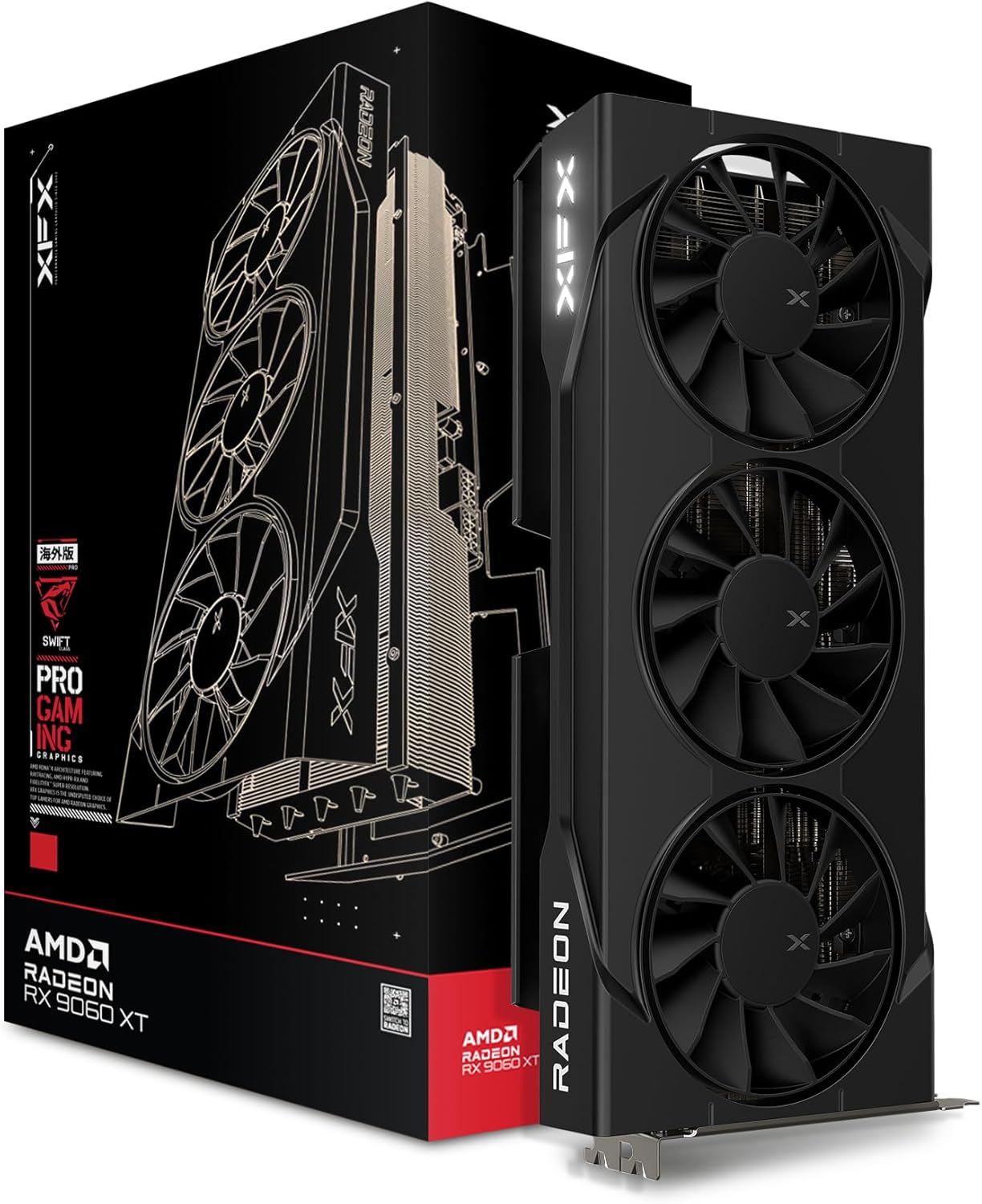
#6. XFX Swift RX 9060 XT
Boost Clock
GDDR6 VRAM
Architecture
You’re getting serious value here: the RX 9060 XT with 16GB GDDR6 delivers strong 1440p performance, and the 3320MHz boost clock keeps it competitive against pricier cards. XFX’s SWFT triple-fan solution holds temperatures in check during long sessions, and the 4.6-star rating across 400+ reviews backs it up.
Expect a large triple-fan card, so measure your case before ordering. Memory bandwidth and ray tracing fall behind NVIDIA rivals at this tier, so if you’re chasing path-traced visuals you may look elsewhere. For straightforward high-FPS 1080p and 1440p gaming on a budget, it’s a smart buy.
Pros
- Excellent price-to-performance
- 16GB VRAM capacity
- Effective triple-fan cooling
Cons
- Large triple-fan footprint
- Weaker ray tracing
- Only two DisplayPorts
Specifications
#7. ASUS Prime RTX 5060 Ti
Compact Certified
16GB Memory
AI TOPS
You get an SFF-Ready Enthusiast card with 16GB of GDDR7 and DLSS 4 support, making it one of the safest picks for small-form-factor builds. The triple-fan Axial-tech cooler and 2.5-slot design balance thermals and compatibility, and 758 AI TOPS gives you headroom for creative and AI workloads.
It’s a 1080p/1440p-class GPU, so don’t expect 4K-max performance despite the premium memory. The triple-fan layout is longer than dual-fan alternatives, which can matter in tiny cases. If you want NVIDIA features and DLSS in a compact, reliable package, it’s excellent; value-focused builders may compare AMD alternatives.
Pros
- SFF-Ready certified
- 16GB GDDR7 memory
- DLSS 4 support
Cons
- Midrange raw performance
- Longer than dual-fan cards
- Ray tracing limited at 4K
Specifications
#8. ASUS Dual RTX 5060 Ti OC
Silent Technology
Compact Card
AI Upscaling
You get a tidy 9-inch dual-fan card with 16GB of GDDR7 and a 2632MHz OC boost clock, ideal for smaller cases where triple-fan cards won’t fit. 0dB technology stops the fans entirely at idle, so your desktop stays whisper-quiet during everyday use, and dual BIOS toggles between quiet and performance modes.
Performance is solidly midrange: great for 1080p high-refresh and capable 1440p, but not a 4K card. The dual-fan cooler works hard under sustained loads, so expect warmer-than-flagship temps. If you want NVIDIA’s DLSS 4 ecosystem in a compact, quiet card, it’s a strong fit; hardcore 4K gamers should step up a tier.
Pros
- Compact 9-inch length
- 0dB silent idle
- 16GB GDDR7 memory
Cons
- Midrange performance tier
- Dual fans run warm
- Limited 4K capability
Specifications
#9. ASRock RX 7600 Challenger Pro
Gaming Focus
32MB Cache
Low Power Draw
You get an affordable RDNA 3 card with a 2695MHz boost clock and 32MB Infinity Cache, delivering smooth high-refresh 1080p and solid 1440p gaming. The triple-fan Challenger Pro cooler with 0dB silent mode keeps things quiet, and it sips power through a single 8-pin on a 550W PSU.
The 8GB of VRAM is the main limitation — modern titles at higher settings can exhaust it, and the PCIe 4.0 x8 interface is narrower than competitors. At 303mm it’s also longer than you’d expect for this class. If you’re a budget 1080p gamer or upgrading an older system, it works well; future-proofers should spend more.
Pros
- Affordable entry price
- Low 550W PSU requirement
- Quiet 0dB mode
Cons
- Only 8GB VRAM
- PCIe x8 interface
- Long for its class
Specifications
#10. GIGABYTE RTX 3060 WINDFORCE OC
Compact Size
GDDR6 VRAM
2nd Gen Ray Tracing
You get a genuinely compact 200mm card with 12GB of GDDR6, which is generous VRAM for the price bracket and handy for VRAM-hungry indie titles and light creative work. The two-fan WINDFORCE cooler keeps this 1792MHz card cool in small builds, and you still get DLSS and second-gen ray tracing support.
This is last-gen Ampere silicon, so raw performance trails newer RDNA 4 and Blackwell cards significantly, and you’re limited to 1080p-class gaming. If you need a small, cheap NVIDIA card for an older PCIe system or a media/entry build, it fits well; performance-per-dollar hunters should favor current-gen options.
Pros
- Very compact 200mm
- 12GB VRAM capacity
- DLSS and RT support
Cons
- Previous-gen performance
- 1080p-class only
- Older architecture
Specifications
Finding the Right GPU: A Smarter Way to Shop for Your Next Video Card
A video card is often the single most expensive component in a gaming or creative PC, and it’s also the one that determines how your system feels day to day. That’s why it deserves more thought than a quick glance at a review score. The “best” card isn’t a universal answer — it’s the one that matches your monitor, your games or workloads, and the rest of your build. Shopping smart means looking past the headline model name and understanding what you’re actually paying for.
The Specs That Make or Break a Graphics Card Purchase
- Performance tier for your resolution. A card that’s overkill at 1080p may struggle at 4K, and vice versa. Match the card’s class to your display before anything else.
- VRAM capacity. Modern games and creative applications are increasingly memory-hungry. Skimping here can cause stuttering and forced settings reductions sooner than you’d expect.
- Cooling and acoustics. Two cards with the same chip can behave very differently depending on the cooler design. Check thermal reviews and noise levels, not just benchmark charts.
- Power supply requirements. Confirm your PSU has the wattage and connectors the card needs. A new GPU can quietly demand an upgrade elsewhere in your build. Our guide to picking the right GPU covers PSU requirements and other compatibility checks in detail.
- Physical fit in your case. High-end cards have grown long, tall, and heavy. Measure your case’s clearance before checkout, not after.
- Sticking to your budget. Decide your ceiling before browsing, and remember that spending slightly less on the GPU often frees up money for a better monitor — which can improve your experience more than a marginal performance bump.
Pitfalls That Burn First-Time GPU Buyers
- Buying for a resolution you don’t have. Paying a premium for 4K performance while gaming on a 1080p monitor is money left on the table.
- Ignoring the rest of the system. An aging CPU or a modest power supply can bottleneck even a great card, muting the upgrade you were counting on.
- Chasing brand loyalty over value. The same GPU chip appears in cards from multiple manufacturers at different prices, cooler designs, and warranty terms — the model name alone doesn’t tell the whole story.
Take your time, cross-check independent reviews and benchmarks, and buy the card that fits your setup — not the one topping a chart.
The Best Video Card Tom’s Hardware Readers Should Grab
The ASUS Prime Radeon RX 9070 XT OC is the one to beat for enthusiasts chasing top-tier RDNA 4 performance, while the GIGABYTE RX 9070 XT Gaming OC is best for gamers who want the same horsepower with quieter triple-fan cooling. On the midrange side, the ASUS Dual RTX 5060 Ti 16GB White OC is best for builders wanting DLSS 4 muscle in a clean white theme, and the XFX Swift RX 9060 XT OC is best for 1080p gamers stretching every dollar. Value hunters still get solid options in the ASRock RX 7600 Challenger Pro and GIGABYTE RTX 3060 WINDFORCE.
Every card here earns its spot — check the buttons above for current prices and availability before they sell out.
Final 3 Picks: All-Rounder, 1440p Powerhouse, and Compact Build
Ready to decide? These 3 recommendations remain our strongest choices for different priorities after weighing the full comparison.
ASUS Prime RX 9070 XT OC
- 16GB GDDR6 memory
- 3030MHz OC boost
- Phase-change thermal pad
ASUS Dual RTX 5060 Ti White
- 16GB GDDR7 memory
- 2632MHz OC boost clock
- DLSS 4 support