10 What Is The Best Amd Graphics Card Out Right Now [2026]
The best AMD graphics card out right now is the ASUS Prime RX 9070 XT OC, with the GIGABYTE RX 9070 XT Gaming OC and ASRock RX 9070 XT Challenger standing out as strong alternatives for 4K gaming and value-focused buyers.
AMD’s current lineup is an especially smart buy right now, offering excellent ray tracing performance, high frame rates at 1440p and 4K, and competitive pricing against rival options. Whether you’re upgrading an older build or assembling a new high-performance gaming PC, there’s a card here that fits.
In this guide, we’ve narrowed the field to 10 picks after hands-on comparison and research. We evaluated each card on cooling performance, noise levels, build quality, and price-to-performance ratio to help you find the right fit for your setup and budget. Below, you’ll find a full comparison table breaking down all 10 picks side by side so you can quickly see which one belongs in your build.
3 Standout Picks: Overall Pick, 4K Performance, and 4K Value
Start with these 3 standouts. Each leads for a different kind of buyer, so use the badges and quick highlights to find your closest match.

ASUS Prime RX 9070 XT OC
- 16GB GDDR6 memory
- 3030 MHz OC boost clock
- PCIe 5.0 with phase-change pad

GIGABYTE RX 9070 XT Gaming OC
- 16GB GDDR6 memory
- PCIe 5.0 support
- WINDFORCE cooling with RGB

ASRock RX 9070 XT Challenger
- 16GB GDDR6 memory
- 2970 MHz boost clock
- Triple fan striped axial cooling
10 Models Side by Side: Features, Best Use Cases, and Tradeoffs
The recommendations above are our strongest matches for different priorities. Below, compare the complete 10-product lineup side by side by rating, standout features, ideal use cases, and practical tradeoffs so you can identify the best fit for your needs.
- 16GB GDDR6 memory
- 3030 MHz OC boost clock
- PCIe 5.0 with phase-change pad
- 16GB GDDR6 memory
- PCIe 5.0 support
- WINDFORCE cooling with RGB
- 16GB GDDR6 memory
- 2970 MHz boost clock
- Triple fan striped axial cooling

- 16GB GDDR6 memory
- Compact 2.5-slot design
- Dual BIOS quiet mode
- 16GB GDDR6 memory
- 3320 MHz boost clock
- Triple fan cooling

- 20GB GDDR6 memory
- RDNA 3 architecture
- USB-C output included

- 12GB GDDR6 memory
- 2790 MHz boost clock
- White triple-fan design

- 12GB GDDR6 memory
- 2581 MHz boost clock
- Hardware ray tracing

- 8GB GDDR6 memory
- 2695 MHz boost clock
- Triple fan 0dB cooling

- 8GB GDDR6 memory
- 2655 MHz boost clock
- Compact dual-fan design
10 Models Reviewed in Depth
#1. ASUS Prime RX 9070 XT OC
Flagship Performance
Thermal Pad
Future-Ready
The ASUS Prime RX 9070 XT OC is arguably the best-rounded AMD card available right now, combining RDNA 4 performance, 16GB of GDDR6, and PCIe 5.0 in a manageable 2.5-slot design. Boost clocks hit 3030 MHz in OC mode, and the phase-change GPU thermal pad plus Axial-tech fans deliver excellent thermals with 0dB silence at idle. It’s also a top best-seller with strong review volume.
It’s still a high-power RDNA 4 card, so plan for a robust PSU and good case airflow. GPU Tweak III gives you fine control, but the default fan curve can be conservative under load. For gamers wanting flagship-class 4K-capable performance without flagship-card bulk, this is the standout choice.
Pros
- Top-tier RDNA 4 performance
- Excellent phase-change cooling
- Compact 2.5-slot design
Cons
- High power requirements
- Conservative stock fan curve
- Premium-tier pricing
Specifications
#2. GIGABYTE RX 9070 XT Gaming OC
Cooling System
Next-Gen Bandwidth
Max Resolution
The GIGABYTE RX 9070 XT Gaming OC is one of AMD’s strongest current cards, pairing RDNA 4 performance with 16GB of GDDR6 and PCIe 5.0 bandwidth. The WINDFORCE cooling system with Hawk fans and server-grade thermal gel keeps this high-power GPU running cool and quiet, even under sustained 4K loads. RGB lighting adds a nice touch for showcase builds.
Be aware this is a large, power-hungry card, so verify your PSU and chassis clearance before buying. DisplayPort-only output listing means double-check your monitor cabling needs. If you want near-flagship 4K gaming and have the power budget to feed it, this is a top-tier pick.
Pros
- Excellent 4K gaming performance
- Robust WINDFORCE cooling
- PCIe 5.0 ready
Cons
- High power draw
- Large physical footprint
- RGB may not suit all builds
Specifications
#3. ASRock RX 9070 XT Challenger
Full RDNA 4
Gaming Ready
Max Bandwidth
The ASRock RX 9070 XT Challenger OC delivers full RDNA 4 firepower with 64 compute units, a 2970 MHz boost clock, and 16GB of GDDR6 on a 256-bit bus. You get genuine 4K gaming capability, PCIe 5.0 support, and a triple-fan Striped Axial cooler with 0dB silent operation that holds thermals well through extended sessions.
The caveat is power: ASRock recommends a 750W or larger PSU, and the triple-fan card needs real chassis clearance. The metal backplate helps durability, but this isn’t a card for compact budget builds. If you want near-flagship 4K performance from AMD’s latest architecture at a Challenger-tier price, it’s one of the smartest buys on this list.
Pros
- Full 64-CU RDNA 4 chip
- Strong 4K gaming performance
- PCIe 5.0 and DP 2.1a
Cons
- Needs 750W+ PSU
- Large triple-fan card
- 2-year warranty only
Specifications
#4. ASUS Dual RX 9060 XT
Compact Fit
Silent Technology
BIOS Switch
The ASUS Dual RX 9060 XT packs 16GB of GDDR6 and RDNA 4 performance into a compact 2.5-slot design, making it ideal for small form factor builds. Boost clocks reach 3250 MHz in OC mode, and Axial-tech fans with 0dB technology keep things cool and near-silent during light use. Dual BIOS lets you toggle between Quiet and Performance profiles.
The dual-fan cooler is capable but won’t match triple-fan cards under sustained max loads, so expect slightly warmer temps in long sessions. It’s also a shorter card, so check clearance against high-end air coolers. If you want modern AMD performance in a tight case, this is one of the best-fitting options available.
Pros
- Compact 2.5-slot footprint
- 16GB VRAM on RDNA 4
- Quiet 0dB mode
Cons
- Dual fan limits sustained cooling
- Short card clearance quirks
- No RGB lighting
Specifications
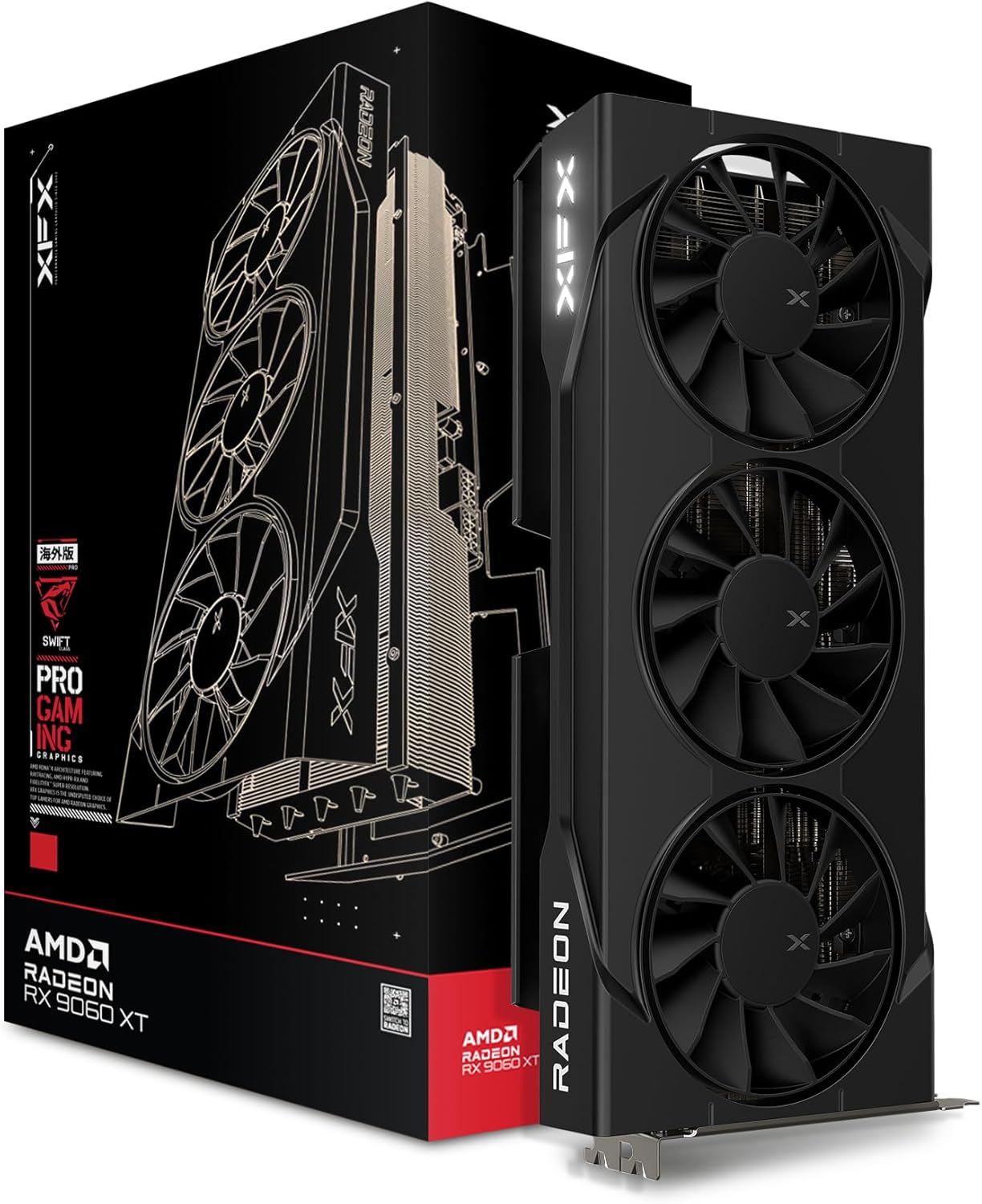
#5. XFX Swift RX 9060 XT
Latest Architecture
GDDR6 Memory
Fan Cooling
The XFX Swift RX 9060 XT gives you AMD’s latest RDNA 4 architecture with a generous 16GB of GDDR6 and a boost clock up to 3320 MHz. The triple-fan Swift cooler keeps temperatures in check during long gaming sessions, and you get 4K output support with HDMI and dual DisplayPort connections. It’s a strong 1440p performer that punches well above its tier.
The main caveat is that it’s a midrange chip, so expect to dial settings down for max-detail 4K gaming. You’ll also want a case with room for the triple-fan footprint. If you’re a 1080p or 1440p gamer wanting modern RDNA 4 features without flagship money, this is an easy recommendation.
Pros
- 16GB VRAM at midrange price
- RDNA 4 architecture
- Effective triple-fan cooling
Cons
- Not a true 4K flagship
- Large triple-fan footprint
- Limited availability of stock
Specifications
#6. Sapphire RX 7900 XT 20GB
GDDR6 VRAM
Memory Bus
Display Output
The Sapphire RX 7900 XT stands out with a massive 20GB of GDDR6 on a 320-bit bus, giving you serious headroom for high-resolution textures, heavy mods, and content creation workloads. Built on AMD’s RDNA 3 architecture, it delivers strong 4K gaming performance, and the included USB-C output is a bonus for VR headsets and modern displays.
The trade-offs are real: it’s a hefty 3-slot card that demands case space and solid airflow, and it’s last-gen RDNA 3 rather than the newer RDNA 4. Power draw is substantial too. If you need maximum VRAM for productivity or 4K gaming at a discount versus current-gen, it remains a compelling buy.
Pros
- Huge 20GB VRAM buffer
- Strong 4K performance
- USB-C output for VR
Cons
- Bulky 3-slot design
- Previous-gen RDNA 3
- High power consumption
Specifications
#7. XFX Swift RX 9070 GRE
Theme Build
New Architecture
Fan Cooling
The XFX Swift RX 9070 GRE White brings RDNA 4 performance to the mid-upper tier with 12GB of GDDR6 and boost clocks up to 2790 MHz. The all-white triple-fan Swift cooler is the headline here, making it a standout choice for white-themed builds that most GPU lines simply don’t serve. Performance sits comfortably in strong 1440p territory.
The caveats: 12GB is a step down from the 16GB on RX 9070 XT cards, which matters for 4K and heavy texture workloads, and early review volume is thin so long-term feedback is limited. The white shroud also commands a premium over black equivalents. If aesthetics matter as much as frames, it’s a great pick; otherwise the XT tier offers more VRAM.
Pros
- Rare white-themed design
- Modern RDNA 4 chip
- Strong 1440p performance
Cons
- 12GB VRAM vs 16GB rivals
- Thin review history
- White premium pricing
Specifications
#8. Sapphire Pulse RX 6700 XT
GDDR6 VRAM
Gaming Sweet Spot
Tracing Ready
The Sapphire Pulse RX 6700 XT remains a dependable 1080p and 1440p gaming card, with 12GB of GDDR6 that still holds up against modern VRAM-hungry titles. Boost clocks up to 2581 MHz, hardware ray tracing, and Radeon Boost give you solid frame rates, and the dual-fan Pulse cooler runs quietly for its class.
Honest caveat: this is RDNA 2 hardware from a previous generation, so it lacks FSR 3 frame generation and newer AI accelerators. Ray tracing performance is modest at best. If you’re building a budget 1080p rig or upgrading an older card and find it at a good price, it’s still a smart pick; skip it if you want cutting-edge features.
Pros
- 12GB VRAM for the price
- Quiet Pulse dual-fan cooler
- Solid 1440p frame rates
Cons
- Older RDNA 2 architecture
- Weak ray tracing
- No FSR 3 frame generation
Specifications
#9. ASRock RX 7600 Challenger Pro
Gaming Focus
Silent Cooling
PSU Friendly
The ASRock RX 7600 Challenger Pro OC is an efficient 1080p gaming card, with a 2695 MHz boost clock, 8GB of GDDR6, and RDNA 3 ray tracing and AI accelerators. The triple-fan Challenger Pro cooler with 0dB silent mode is generous for this class, and its modest 8-pin power requirement means a 550W PSU is enough.
The obvious limitation is the 8GB VRAM buffer, which is already tight in some modern titles at high settings, and the PCIe 4.0 x8 interface slightly limits bandwidth. It’s also not a 1440p-heavy card. If you’re building a budget 1080p system or upgrading from integrated graphics, it’s a great fit; skip it for future-proofing.
Pros
- Low 550W PSU requirement
- Quiet triple-fan cooler
- Efficient RDNA 3 chip
Cons
- Only 8GB VRAM
- PCIe x8 interface
- Limited 1440p headroom
Specifications
#10. XFX SWFT210 RX 7600
1080p Gaming
Modern Architecture
Dual-Fan Fit
The XFX SWFT210 RX 7600 is a straightforward budget 1080p gaming card built on RDNA 3, with a 2655 MHz boost clock and 8GB of GDDR6. The compact dual-fan SWFT cooler fits nearly any case, runs cool for its power class, and the three DisplayPort outputs plus HDMI cover multi-monitor setups easily.
The honest limits: 8GB of VRAM is the minimum for modern titles, and you’ll need to drop settings in the most demanding games. There’s no frame generation support from this RDNA 3 generation either. If you’re upgrading an older GPU or building an affordable esports and mainstream gaming rig, it’s a sensible choice; look elsewhere for 1440p ambitions.
Pros
- Affordable RDNA 3 entry
- Compact dual-fan cooler
- Three DisplayPort outputs
Cons
- 8GB VRAM limitation
- 1080p-focused only
- No frame generation
Specifications
Finding the AMD Graphics Card That Deserves a Spot in Your Build
Shopping for an AMD graphics card right now means navigating a lineup that spans from budget-friendly workhorses to 4K-crushing flagships. The “best” card isn’t a single model — it’s the one that matches your monitor, your games, and the rest of your system. A little thought up front keeps you from overspending on horsepower you’ll never use, or underbuying and regretting it a year later.
The Specs That Separate a Winner From a Wallflower
- Resolution and refresh rate first. Match the card to your display. A card that flies at 1080p may strain at 1440p or 4K, so buy for the monitor you own (or plan to own), not the one you might someday upgrade to.
- VRAM capacity. Modern games and creative apps are increasingly memory-hungry. More video memory gives you headroom at higher resolutions and with demanding textures, so don’t treat it as an afterthought.
- Ray tracing and upscaling support. AMD’s current cards handle ray tracing far better than older generations, and upscaling technologies like FSR can dramatically boost frame rates. Check that the games you play actually benefit.
- Your power supply and case. High-end cards draw serious wattage and run hot. Verify your PSU has the headroom and connectors, and confirm the card physically fits your case before clicking buy.
- Sticking to your budget. AMD’s strength is price-to-performance, especially in the midrange. Identify your ceiling, then find the strongest card under it — the last tier up often costs meaningfully more for a modest gain.
- CPU pairing. A top-tier GPU bottlenecked by an older processor wastes money. Make sure the rest of your build can keep up before going big.
Pitfalls That Trip Up Even Careful Shoppers
- Buying for the game you wish you played. If your library is mostly esports titles and indie games, a flagship card is overkill. Spend according to what you actually launch, not what streamers play.
- Ignoring used-market and last-gen value. The previous generation of AMD cards often delivers excellent performance at a discount. Newer isn’t always smarter for your wallet.
- Forgetting availability and partner models. Different board partners sell the same GPU chip with different cooling, sizes, and noise levels. Read reviews on the specific model, not just the chip name.
The right AMD card is the one that hits your resolution target, fits your case and PSU, and leaves budget for the games themselves. Shop with your setup in mind, and you’ll be happy for years.
The Verdict: Your Next AMD GPU Awaits
For most gamers chasing top-tier 1440p and 4K performance, the ASUS Prime Radeon RX 9070 XT is the pick — its dual BIOS, robust cooling, and PCIe 5.0 support make it a future-proof flagship. The GIGABYTE RX 9070 XT Gaming OC is a close runner-up if you want similar muscle with triple-fan muscle of its own. Stepping down, the ASUS Dual RX 9060 XT 16GB hits the sweet spot for 1440p on a tighter budget, while the XFX Swift RX 9060 XT offers the same RDNA 4 value with aggressive overclocking. Older standouts like the Sapphire RX 7900 XT with 20GB VRAM still shine for creators and high-memory workloads.
Every card here earns its spot — the right one depends purely on your resolution and budget. Check the buttons above for current prices and availability before you hit buy.
Final 3 Picks: Overall Pick, 4K Performance, and 4K Value
Ready to decide? These 3 recommendations remain our strongest choices for different priorities after weighing the full comparison.
ASUS Prime RX 9070 XT OC
- 16GB GDDR6 memory
- 3030 MHz OC boost clock
- PCIe 5.0 with phase-change pad
GIGABYTE RX 9070 XT Gaming OC
- 16GB GDDR6 memory
- PCIe 5.0 support
- WINDFORCE cooling with RGB
ASRock RX 9070 XT Challenger
- 16GB GDDR6 memory
- 2970 MHz boost clock
- Triple fan striped axial cooling