10 Best Home Theater Graphics Card [2026]
The best home theater graphics cards offer a significant upgrade for visual fidelity and smooth playback, with top contenders like the ASUS RX 9070 GRE EVO for 1440p gaming, the MSI RTX 3060 12G OC for high-end gaming, and the GIGABYTE GT 710 2GB for entry-level desktops providing excellent options.
Choosing the right GPU is crucial for an immersive home theater experience, enabling you to enjoy 4K content and demanding games with stunning clarity. A powerful graphics card ensures that your media center can handle high refresh rates and advanced graphical features without stuttering, making every movie and game session more enjoyable.
In this roundup, we’ve evaluated a wide range of GPUs to bring you our top 10 picks. Our testing focused on performance metrics, power efficiency, and value for money to help you make an informed decision. We’ve considered various needs, from casual media streaming to serious gaming, ensuring there’s a card for every setup. Dive into our detailed comparison table below to find the perfect graphics card for your home theater.
3 Standout Picks: 1440p Gaming, High-End Gaming, and Entry-Level Desktops
Start with these 3 standouts. Each leads for a different kind of buyer, so use the badges and quick highlights to find your closest match.


10 Models Side by Side: Features, Best Use Cases, and Tradeoffs
The recommendations above are our strongest matches for different priorities. Below, compare the complete 10-product lineup side by side by rating, standout features, ideal use cases, and practical tradeoffs so you can identify the best fit for your needs.
- 12GB GDDR6 Memory
- Radeon RX 9070 GRE
- PCIe 5.0 Support
- 12GB GDDR6 Memory
- RTX 3060 Chipset
- PCIe 4.0 Support
- 2GB DDR3 RAM
- HDMI/DVI/VGA
- Low Profile Design

- 2GB GDDR5 Memory
- 4x HDMI Ports
- Single-Slot Design

- 4GB GDDR5 Memory
- 4x HDMI Ports
- Fanless Cooling
- 4GB GDDR5 Memory
- 4x HDMI Outputs
- Silent Operation

- 4GB GDDR5 Memory
- Quad HDMI Output
- Silent Cooling

- 4GB DDR3 Memory
- HDMI/DVI/VGA
- Low Profile Design
- 4GB DDR3 Memory
- Triple HDMI/VGA/DVI
- Standard Profile

- 1GB DDR3 Memory
- HDMI and VGA
- Low Profile
10 Models Reviewed in Depth
#1. ASUS RX 9070 GRE EVO
Gaming
GDDR6
Ready
You’ll be blown away by the ASUS Prime Radeon RX 9070 GRE EVO’s exceptional 1440p gaming performance and 12GB of GDDR6 memory. This card is a beast, delivering high frame rates and smooth visuals in demanding titles. The PCIe 5.0 support and latest HDMI/DisplayPort outputs ensure you’re equipped for next-generation displays and connectivity.
Its 2.5-slot design and powerful cooling system mean it requires ample space within your PC case. While it excels at gaming, it’s overkill for basic media playback. If you’re aiming for top-tier performance at 1440p and beyond, this ASUS card is a phenomenal choice.
Pros
- Outstanding 1440p gaming performance
- 12GB GDDR6 memory
- Latest connectivity standards
Cons
- Requires significant case space
- Overkill for non-gaming
- Higher power draw
Specifications
#2. MSI RTX 3060 12G OC
GDDR6
Architecture
Ready
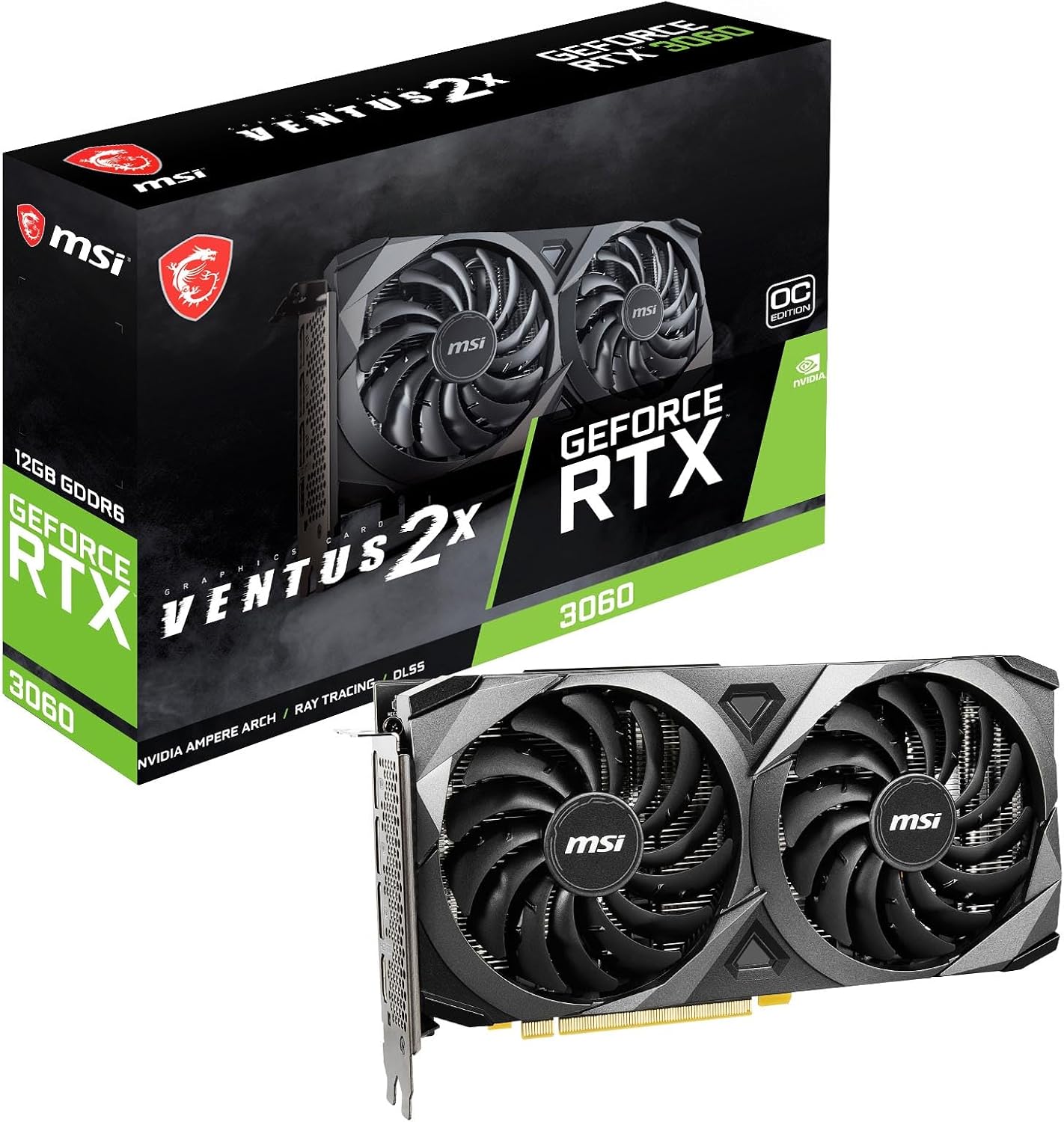
You’ll experience incredible gaming performance with the MSI RTX 3060, powered by NVIDIA’s Ampere architecture and 12GB of GDDR6 memory. This card is built for modern titles, offering smooth frame rates at 1080p and 1440p resolutions, with excellent support for ray tracing and DLSS. The PCIe 4.0 interface ensures you’re ready for the latest gaming platforms.
While this card is a powerhouse for gaming, it’s overkill for basic home theater playback or simple office tasks. Its larger size might also be a consideration for smaller PC cases. If you’re a serious gamer looking for a high-performance card that balances power and price, the RTX 3060 is an outstanding choice.
Pros
- Excellent gaming performance
- 12GB of fast GDDR6 memory
- Supports Ray Tracing and DLSS
Cons
- Overkill for HTPC use
- Requires adequate case space
- Higher power consumption
Specifications
#3. GIGABYTE GT 710 2GB
Upgrade
Design
Output
You’ll find the GIGABYTE GT 710 to be a fantastic value for upgrading entry-level desktops, offering multiple display outputs (HDMI, DVI, VGA) for versatile connectivity. Its low profile design makes it suitable for a wide range of PC cases, including smaller ones. With 2GB of DDR3 RAM, it provides a noticeable improvement over integrated graphics for everyday tasks and media playback.
This card is not intended for gaming or demanding graphical workloads. The DDR3 memory is a step down from GDDR5, limiting its performance in more intensive applications. It’s an excellent choice for users needing a reliable, quiet, and compact graphics solution for basic desktop use and multi-monitor setups.
Pros
- Excellent value for money
- Versatile display outputs
- Quiet, low-profile design
Cons
- Limited gaming performance
- DDR3 memory
- Not for intensive tasks
Specifications
#4. ASUS GT 730 2GB
Passive Cooling
Multi-Display
Compact
You’ll find the ASUS GT 730 to be an excellent choice for building a quiet home PC, thanks to its silent passive cooling and single-slot design that fits into smaller cases. The four HDMI ports allow for easy multi-monitor setups, enhancing productivity or your home theater experience. With 2GB of GDDR5 memory, it’s well-suited for everyday tasks, multimedia playback, and light graphical applications.
While this card offers great silent operation and display flexibility, the 2GB of VRAM might be a limitation for more demanding tasks or higher resolutions. It’s ideal for users prioritizing silence and multi-display capabilities for HTPCs or office use, rather than gaming. If you need a compact, quiet card for basic visual output, this ASUS model is a strong contender.
Pros
- Extremely quiet operation
- Supports up to 4 displays
- Compact single-slot design
Cons
- Only 2GB VRAM
- Not for gaming
- Limited to 1080p on multiple displays
Specifications
#5. Vandossy GT 730 4GB
Multi-Monitor
Fanless
Efficient
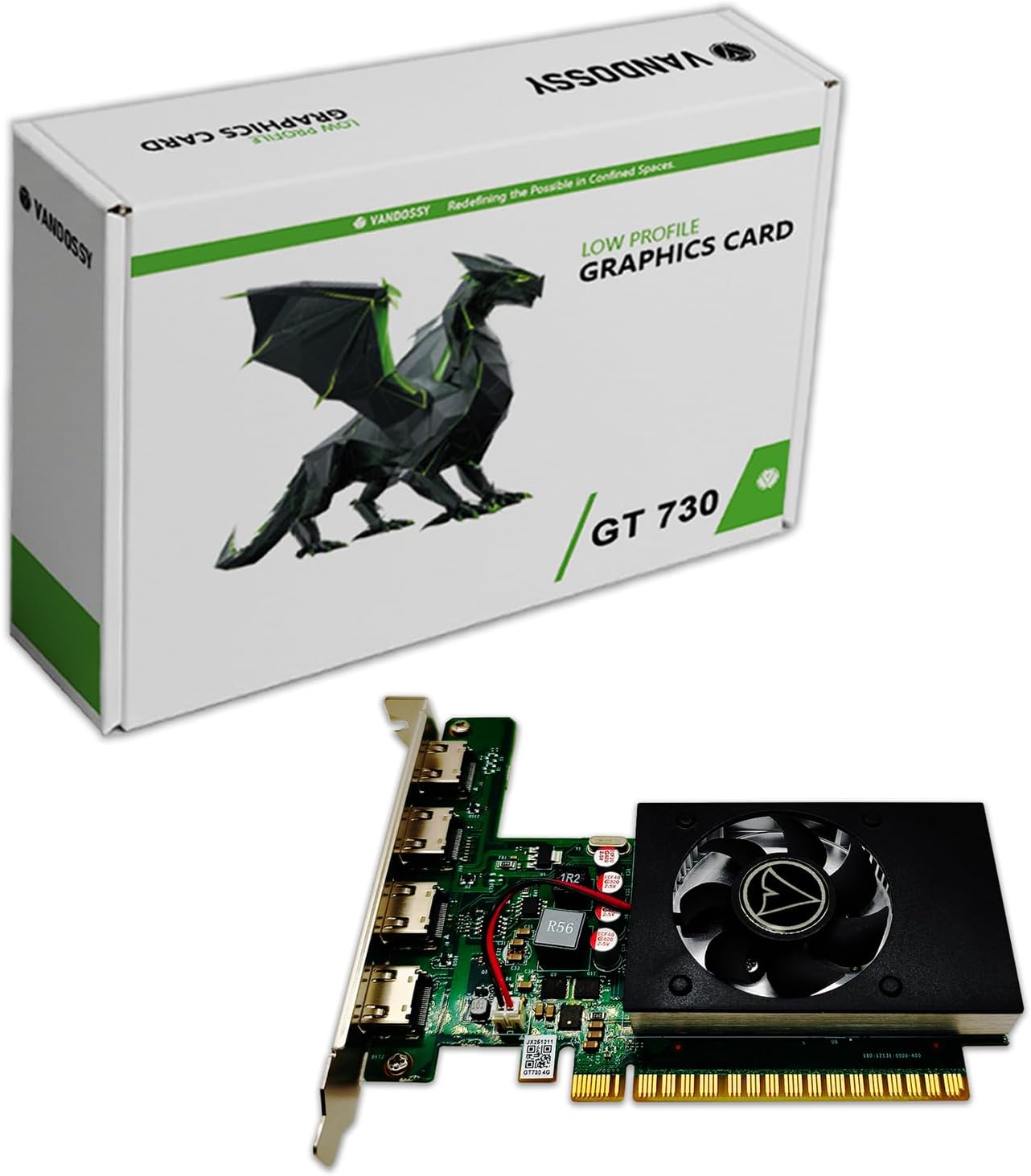
You’ll be impressed by the Vandossy GT 730’s ability to drive four HDMI displays simultaneously, making it a powerhouse for multitasking and business applications. The 4GB of GDDR5 memory ensures smooth performance for high-resolution content and everyday tasks. Its fanless passive cooling design guarantees completely silent operation, ideal for quiet environments like offices or home theaters.
While this card excels at display output and silent operation, its gaming capabilities are limited. It’s best suited for users who need extensive screen real estate for productivity or media consumption, rather than high-end gaming. If you’re looking for a silent, multi-display solution for work or HTPC use, this card is an excellent choice.
Pros
- Four HDMI outputs
- Completely silent operation
- Energy efficient
Cons
- Not for gaming
- Limited to 30Hz at 4K
- Basic graphics performance
Specifications
#6. Vandossy GT 730 4GB
Media Center
Fanless
Optimized
You’ll find this Vandossy GT 730 card to be an excellent choice for HTPC builds, offering four HDMI outputs for versatile media center setups. The 4GB of GDDR5 memory is ample for smooth 4K video playback and multitasking. Its completely silent operation ensures an immersive audio-visual experience without distracting fan noise.
This card is designed for media playback and productivity, not for gaming. While it supports up to 4K resolution on a single display, it’s best used with four 1080p displays for optimal stability. If you’re building a quiet media PC or a multi-display workstation, this card offers great value and performance.
Pros
- Four HDMI outputs
- Silent, fanless design
- Good for media playback
Cons
- Not suitable for gaming
- 4K limited to 30Hz
- Basic performance
Specifications
#7. ARDIYES GT 740 4GB
Multi-Monitor
Cooling
Compact
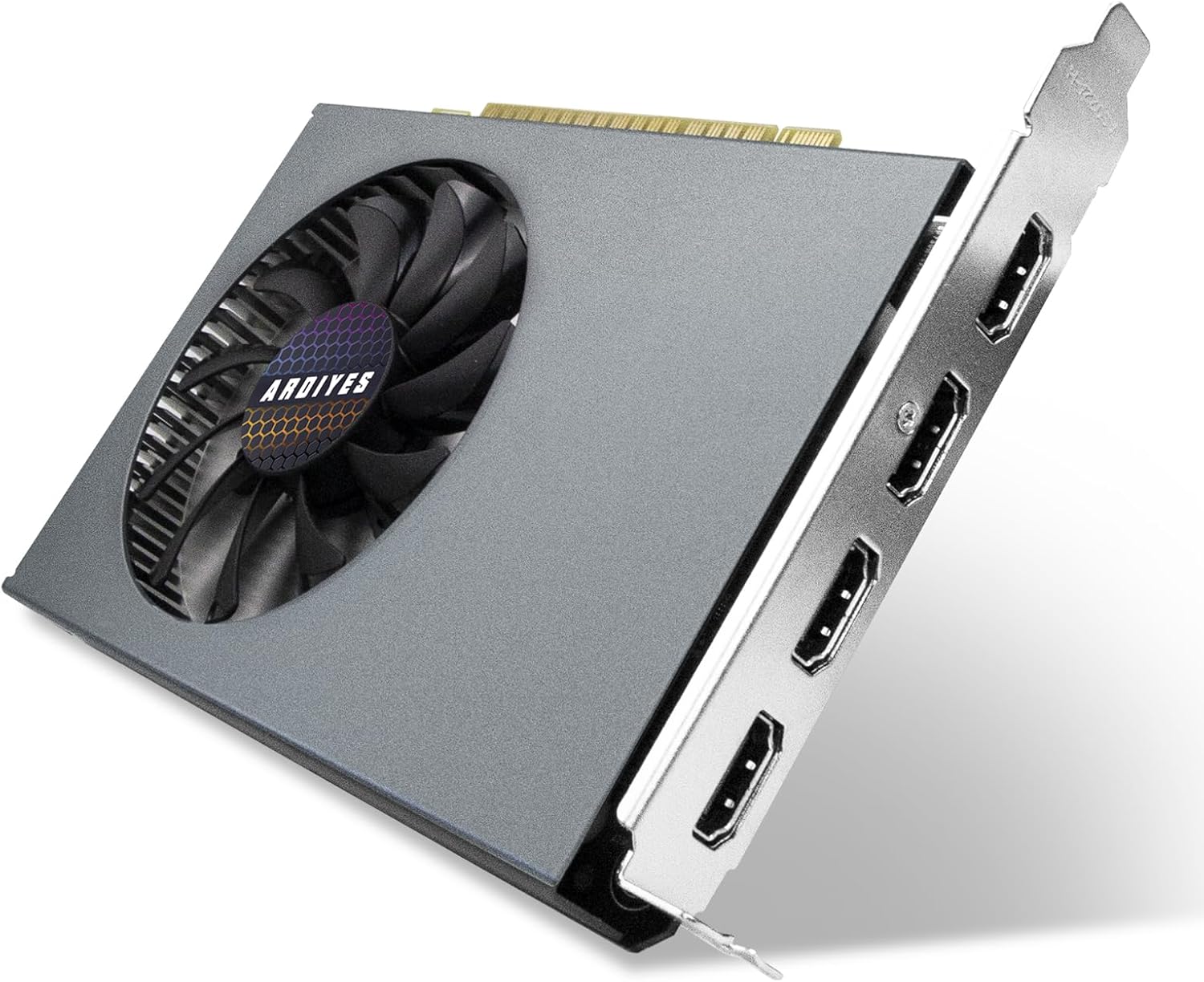
You’ll appreciate the versatility of the ARDIYES GT 740, especially its four HDMI ports which are perfect for a multi-monitor home theater setup. The 4GB of GDDR5 memory ensures smooth playback of 1080P video and handles everyday applications with ease. Its silent cooling system makes it an excellent choice for noise-sensitive environments, ensuring your viewing experience is uninterrupted.
While this card is great for media playback and multi-display productivity, don’t expect it to handle demanding modern games. It’s best suited for users who prioritize display output and quiet operation over raw gaming power. If your needs are primarily for an HTPC or a business workstation, this card is a solid, budget-friendly option.
Pros
- Quad HDMI for multi-monitor
- Silent operation
- Low-profile design
Cons
- Not for demanding gaming
- Older GPU architecture
- Limited to 1080p on all displays
Specifications
#8. SOYO GT 740 4GB
Ready
Design
Output
You’ll find the SOYO GT 740 to be a capable budget option for basic HTPC builds, offering HDMI, DVI, and VGA outputs for versatile connectivity to various displays. The 4GB of DDR3 memory is adequate for smooth 1080P video playback and office multitasking. Its low profile design makes it suitable for slim desktop PCs, and it draws power directly from the PCIe slot, simplifying installation.
This card is not designed for gaming and its DDR3 memory is slower than GDDR5. While it supports Windows 11, performance may be basic. It’s a good choice for users looking to upgrade from integrated graphics for media playback or light productivity tasks in a compact system.
Pros
- Triple display outputs
- Low power consumption
- Suitable for slim PCs
Cons
- DDR3 memory is slower
- Not for gaming
- Basic graphics performance
Specifications
#9. ARDIYES GT 730 4GB
Output
Friendly
Upgrade
You’ll find the ARDIYES GT 730 to be a cost-effective solution for expanding your display capabilities, offering HDMI, VGA, and DVI outputs for broad compatibility. The 4GB of DDR3 memory is sufficient for basic multitasking and 1080P video playback. Its standard profile design ensures it fits into most desktop cases, making it a straightforward upgrade from integrated graphics.
This card is best suited for basic office tasks and media consumption, not for gaming or demanding applications. The DDR3 memory is slower than GDDR5, which can impact performance in certain scenarios. If you need a budget-friendly card for a standard desktop to add multiple displays for productivity, this is a viable option.
Pros
- Triple display outputs
- Affordable upgrade
- Wide compatibility
Cons
- Slower DDR3 memory
- Not for gaming
- Standard profile only
Specifications
#10. QTHREE GT 210 1GB
Factor
Design
Upgrade
You’ll find the QTHREE GT 210 to be a compact and affordable option, particularly suited for small form factor (SFF) PCs due to its low profile design. It offers essential connectivity with HDMI and VGA ports, supporting up to two monitors for basic productivity tasks. The 1GB of DDR3 memory is adequate for web browsing, office applications, and video playback.
This card is not designed for gaming or any graphically intensive tasks; its performance is very basic. Compatibility with Windows 11 is also not supported, which is a significant drawback for modern systems. It’s best for users with older PCs or very specific SFF builds needing a simple display output upgrade.
Pros
- Ideal for SFF cases
- Low power consumption
- Basic display output
Cons
- Very limited performance
- Only 1GB VRAM
- Not compatible with Windows 11
Specifications
Powering Your Cinematic Dreams: The Graphics Card Quest
Building a home theater is about immersion, and at the heart of that visual experience lies the graphics card. It’s the engine that drives the stunning visuals, from crisp 4K movies to vibrant gaming sessions, and choosing the right one can elevate your entertainment from good to truly spectacular. Don’t let the technical jargon intimidate you; a little knowledge goes a long way in finding the perfect visual powerhouse for your setup.
The Pillars of Visual Prowess
When selecting a graphics card for your home theater, several key elements deserve your attention to ensure you’re getting the most bang for your buck.
- Resolution Capabilities: Consider the highest resolution your display supports. A card that can comfortably handle 4K or even 8K output will ensure future-proofed playback of the latest content.
- Video Memory (VRAM): More VRAM is generally better, especially for higher resolutions and complex visual tasks. It allows the card to store more data, leading to smoother performance.
- Connectivity Options: Ensure the card has the necessary ports (like HDMI 2.1) to connect seamlessly with your TV, soundbar, or receiver, supporting the latest audio and video standards.
- Power Consumption and Cooling: A powerful card will draw more power and generate heat. Check the recommended power supply unit (PSU) wattage and ensure your case has adequate airflow for optimal performance and longevity.
- Sticking to your budget: Home theater graphics cards span a wide range. Identify your essential needs and prioritize features that directly impact your viewing experience, rather than getting swayed by bells and whistles you might not utilize.
Navigating the Upgrade Aisle: Common Missteps
Even with the best intentions, a few common pitfalls can lead to buyer’s remorse when picking out a graphics card.
- Overspending on features you’ll never use, like extreme gaming performance, when your primary use is media consumption.
- Underestimating the power supply requirements, leading to system instability or the need for an additional costly upgrade.
- Forgetting to check physical dimensions and ensuring the card will actually fit inside your chosen home theater PC case.
Your Home Theater’s Visual Upgrade Awaits
For cutting-edge performance and immersive visuals, the ASUS Prime Radeon RX 9070 GRE EVO OC Edition is your top pick. If you’re after solid, reliable performance without breaking the bank, the MSI Gaming GeForce RTX 3060 Ventus 2X 12G OC V1 offers a fantastic balance. For budget-conscious builds focused on multi-display setups and basic media playback, cards like the GT 730 and GT 740 series deliver the necessary ports and silent operation.
All these graphics cards are designed to enhance your home theater experience. Don’t wait – check the buttons above to see current availability and snag the perfect card for your setup!
Final 3 Picks: 1440p Gaming, High-End Gaming, and Entry-Level Desktops
Ready to decide? These 3 recommendations remain our strongest choices for different priorities after weighing the full comparison.