10 Best Rtx 4090 Graphics Card [2026]
The best RTX 4090 graphics cards are the ASUS ROG Strix RTX 4090 OC for best overall performance, the NVIDIA RTX 4090 Founders for the best reference design, and the MSI RTX 4090 SUPRIM Liquid X for best liquid cooling.
The RTX 4090 is the most powerful consumer GPU on the market, so choosing the right version matters — differences in cooling design, factory overclocks, and acoustics can noticeably affect real-world performance. Whether you’re building a 4K gaming rig or a content creation workstation, the right card also depends on your case clearance and noise tolerance.
In this guide, we’ve narrowed the field to 10 top picks after hands-on comparison. We evaluated each card on thermal performance, noise levels, build quality, and overall value to help you find the right fit. The full breakdown below compares specs, features, and use cases side by side — the comparison table makes it easy to see which RTX 4090 belongs in your build.
3 Standout Picks: Reference Design, Overall Performance, and Liquid Cooling
Start with these 3 standouts. Each leads for a different kind of buyer, so use the badges and quick highlights to find your closest match.


ASUS ROG Strix RTX 4090 OC
- 24GB GDDR6X memory
- 2640 MHz boost clock
- Vapor chamber cooling

MSI RTX 4090 SUPRIM Liquid X
- AIO liquid cooling
- 2625 MHz boost clock
- Silent operation
10 Models Side by Side: Features, Best Use Cases, and Tradeoffs
The recommendations above are our strongest matches for different priorities. Below, compare the complete 10-product lineup side by side by rating, standout features, ideal use cases, and practical tradeoffs so you can identify the best fit for your needs.
- 16,384 CUDA cores
- DLSS 3 acceleration
- 8K HDR gaming
- 24GB GDDR6X memory
- 2640 MHz boost clock
- Vapor chamber cooling
- AIO liquid cooling
- 2625 MHz boost clock
- Silent operation

- TRI FROZR 3 cooling
- 2595 MHz boost clock
- Copper baseplate design

- Smaller OG form factor
- 2595 MHz OC mode
- Military-grade components
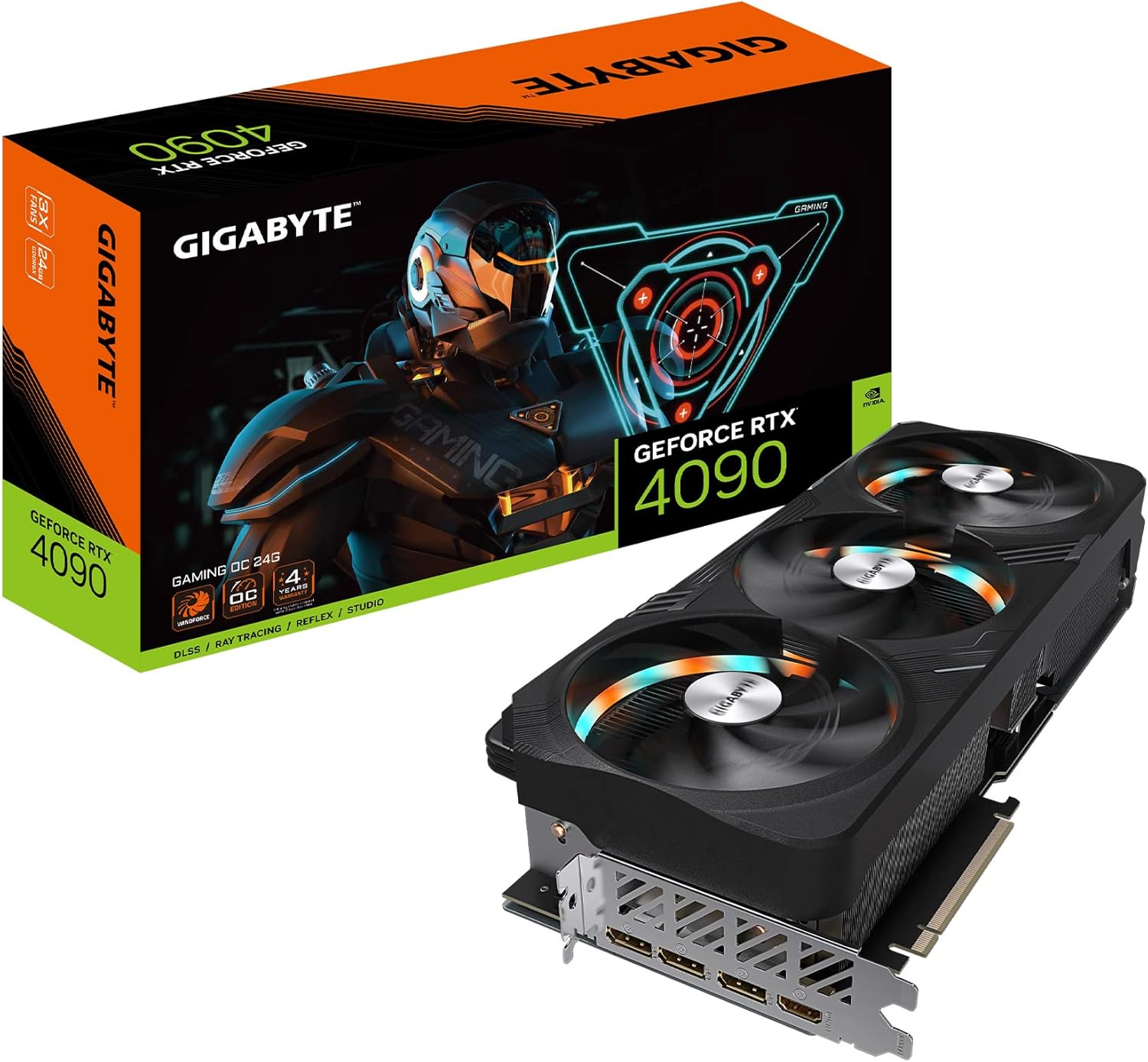
- WINDFORCE cooling system
- Dual BIOS support
- 2535 MHz boost clock

- RGB Fusion lighting
- 2535 MHz core clock
- Anti-sag bracket included

- 3.5-slot fin array
- GPU Tweak III software
- Diecast shroud frame

- Dual ball fan bearings
- Axial-tech fan design
- 24GB GDDR6X memory

- Slim two-fan design
- 24GB GDDR6X memory
- 384-bit memory bus
10 Models Reviewed in Depth
#1. NVIDIA RTX 4090 Founders
Edition Design
CUDA Cores
HDR Gaming
The Founders Edition is NVIDIA’s own take on the RTX 4090, and it delivers the full 16,384 CUDA core experience in a cleaner, more compact two-fan flow-through design than most AIB cards. You get DLSS 3 AI acceleration, third-gen RT cores, and native support for 8K 60Hz HDR gaming straight from the reference spec sheet.
Because it’s the reference card, you won’t find the factory overclocks or elaborate coolers that board partners add, so thermals run a bit warmer under sustained load. Stock can also be hard to find at reasonable markup. If you want the purest 4090 experience in a shorter 12-inch card, this is the one; enthusiasts chasing maximum clocks should look at OC models instead.
Pros
- Compact reference design
- Full 16,384 CUDA cores
- Native 8K HDR support
Cons
- No factory overclock
- Limited retail availability
- Warmer under sustained load
Specifications
#2. ASUS ROG Strix RTX 4090 OC
Chamber Cooling
Boost Clock
Tech Fans
The ROG Strix OC Edition gives you flagship RTX 4090 performance with a 2640 MHz boost clock out of the box. ASUS scaled its Axial-tech fans up for 23% more airflow, and the patented vapor chamber with milled heatspreader keeps temperatures low even during sustained 4K gaming sessions. With 24GB of GDDR6X, you can push max settings, ray tracing, and DLSS 3 without compromise.
The trade-off is size: this is a massive 3.5-slot card at over 14 inches long, so measure your case first and confirm your PSU can handle it. It’s also one of the pricier 4090 variants. If you want the best-cooled, fastest Strix experience and have a full-tower build, this is your card; skip it if you’re working with a compact chassis.
Pros
- Highest factory boost clock
- Excellent vapor chamber cooling
- 3-year warranty included
Cons
- Very large 3.5-slot design
- Premium pricing tier
- Demands strong PSU
Specifications
#3. MSI RTX 4090 SUPRIM Liquid X
Cooled Design
Boost Clock
Sustained Load
The SUPRIM Liquid X moves the 4090’s heat problem into an all-in-one liquid loop, letting the GPU boost to 2625 MHz while staying remarkably quiet. Because the radiator handles the thermal load, you get near-silent sustained performance and a slim graphics card body that frees up case airflow for your CPU and other components.
Installation is more involved than an air-cooled card — you’ll need radiator mounting space and patience with tubes and the pump block. It’s also among the most expensive 4090 variants. If you want the coolest, quietest flagship experience and have a case that supports a 240mm-class radiator, this is exceptional; skip it if you want a simple drop-in GPU install.
Pros
- Excellent liquid cooling
- Very quiet operation
- High 2625 MHz boost
Cons
- Complex installation
- Needs radiator space
- Highest price tier
Specifications
#4. MSI RTX 4090 Gaming X Trio
3 Cooling
Baseplate Design
Boost Clock
MSI’s Gaming X Trio leans hard into thermal engineering. The TRI FROZR 3 design pairs TORX Fan 5.0 blades with a copper baseplate and precision-machined core pipes that pull heat off the GPU and memory fast, so you can run long 4K sessions without thermal throttling. The 2595 MHz boost clock gives you a healthy factory overclock on top of the 24GB GDDR6X.
It’s a big, heavy triple-fan card, so plan for case clearance and use the included support to avoid GPU sag. The airflow-control fins keep noise reasonable, but it’s still audible under full load. If you prioritize cool, quiet sustained performance for gaming or content creation, this is a superb pick; skip it if your case is mid-tower or smaller.
Pros
- Outstanding TRI FROZR 3 cooler
- Strong factory overclock
- Quiet under load
Cons
- Large triple-slot footprint
- Heavy, needs support bracket
- Premium price point
Specifications
#5. ASUS TUF RTX 4090 OG OC
Grade Components
OG Form Factor
OC Mode
The TUF Gaming OG OC brings the RTX 4090 into a smaller, familiar form factor closer to the 30-series footprint, which makes it one of the easier flagship cards to actually fit in a case. You still get 2595 MHz in OC mode, a reversed central fan for less turbulence, and military-grade capacitors with dual ball fan bearings built to last.
Because the card is more compact, the cooler is slightly less extravagant than a Strix, so expect a few degrees more under sustained load — nothing deal-breaking. The TUF aesthetic is understated rather than flashy. If you want full 4090 power in a tighter build with proven durability, this is a smart choice; look elsewhere if you want RGB-heavy styling.
Pros
- Compact OG form factor
- Military-grade durability
- Reversed center fan design
Cons
- Slightly warmer than Strix
- Plain aesthetics
- Still needs robust PSU
Specifications
#6. GIGABYTE RTX 4090 Gaming OC 24G
Triple Fan
BIOS Switch
Verified Reviews
This Gaming OC 24G delivers the complete 4090 package — 24GB of GDDR6X on a 384-bit bus with a 2535 MHz boost clock — and backs it with the WINDFORCE triple-fan cooler, dual BIOS, and a protection back plate. With nearly 300 reviews averaging 4.4 stars, it’s one of the most proven 4090 listings you can buy.
It doesn’t push clocks as high as the Strix or SUPRIM tiers, and the cooler, while capable, isn’t the most exotic on the market. The card is also large, so plan your case layout accordingly. If you want a battle-tested, well-reviewed 4090 without paying for the top-tier cooler tax, this is a strong value pick; overclocking obsessives should step up a tier.
Pros
- Highly reviewed and proven
- Dual BIOS flexibility
- Metal back plate protection
Cons
- Mid-tier boost clock
- Large physical footprint
- Cooler not top-tier
Specifications
#7. GIGABYTE RTX 4090 Gaming OC
Fusion Lighting
Bracket Included
Core Clock
GIGABYTE’s Gaming OC pairs the full RTX 4090 with a 2535 MHz core clock and the WINDFORCE triple-fan cooler, so you get strong 4K performance with solid thermals. RGB Fusion lighting and a metal back plate give it showroom appeal, and the included anti-sag bracket addresses the weight problem every 4090 owner faces.
The card is long and heavy at over two kilograms, so double-check clearance despite the bracket. It also lacks the more elaborate vapor-chamber cooling of pricier rivals, though it stays competitive in gaming. If you want a well-rounded, good-looking 4090 with factory overclock and practical extras, this hits the mark; enthusiasts chasing every last MHz may prefer higher-binned models.
Pros
- RGB Fusion lighting
- Anti-sag bracket included
- Solid factory overclock
Cons
- Long, heavy card
- Cooling trails premium models
- Bulky triple-fan design
Specifications
#8. ASUS ROG Strix RTX 4090
Fin Array
Shroud Frame
III Software
The non-OC ROG Strix 4090 keeps the flagship Strix treatment — a massive 3.5-slot fin array, diecast shroud and frame, and vapor chamber cooling — at a reference-class clock, which makes it a great canvas for your own overclocking via GPU Tweak III. Build quality is exceptional, with high-current power stages and vented backplate airflow.
Since it ships at stock clocks, you’re paying Strix money without the factory boost of the OC Edition, so tune it yourself to extract the value. It’s also enormous, among the largest 4090s available. If you’re an enthusiast who wants premium hardware to overclock manually, this is a rewarding platform; buyers wanting plug-and-play max clocks should grab the OC version.
Pros
- Premium Strix build quality
- Great overclocking headroom
- GPU Tweak III included
Cons
- No factory overclock
- Extremely large card
- Higher price than TUF
Specifications
#9. ASUS TUF RTX 4090 OC
Fan Bearings
Verified Reviews
Tech Airflow
The TUF Gaming OC is the workhorse of ASUS’s 4090 lineup, with dual ball fan bearings rated to last twice as long as conventional designs and Axial-tech fans scaled for 23% more airflow. You get the full 24GB GDDR6X 4090 experience with a factory OC, backed by the most reviews of any card in this roundup — over 300 at 4.4 stars.
The TUF cooler is sturdy but less elaborate than the Strix vapor chamber, so expect slightly higher temps under sustained all-core loads. Aesthetics are utilitarian rather than flashy. If you want a durable, well-proven 4090 for years of 4K gaming without paying Strix prices, this is the sensible pick; skip it if RGB and premium cooling matter most to you.
Pros
- Long-lasting dual ball bearings
- Most-reviewed 4090 listing
- Strong value for money
Cons
- Simpler cooler than Strix
- Utilitarian looks
- Heavy card, needs support
Specifications
#10. MSI RTX 4090 Gaming Slim
Two-Fan Design
Memory Bus
CUDA Cores
The Gaming Slim is MSI’s answer to the 4090’s size problem, packing the full 16,384 CUDA cores and 24GB of GDDR6X on a 384-bit bus into a shorter two-fan card. If your case can’t swallow a triple-slot monster, this lets you keep uncompromised 4K and 8K gaming performance in a tighter footprint.
The compromises are real: a two-fan slim cooler works harder, so expect higher temperatures and more fan noise under sustained load than bulkier 4090s. It’s also a newer listing with very few reviews, so long-term reliability data is thin. If fitting a 4090 into a compact build is your top priority, this works well; if you have the room, a triple-fan model cools better.
Pros
- Compact two-fan design
- Full 4090 spec retained
- Fits smaller cases
Cons
- Fewer reviews so far
- Warmer under load
- Limited availability
Specifications

Cutting Through the Noise: Finding the Right RTX 4090 for Your Build
An RTX 4090 is a serious investment, and unlike most components, the “same” GPU can arrive in half a dozen very different packages. Every board partner takes NVIDIA’s core design and wraps it in its own cooling, power delivery, and physical layout — which means two cards with identical performance ceilings can feel worlds apart in your case. Taking a little extra time to compare versions is the difference between a card that hums along quietly for years and one you quietly regret.
The Details That Separate One 4090 From Another
-
Cooler design and acoustics. The RTX 4090 runs hot under load, so the cooler matters more here than on most cards. Larger, triple-fan designs generally keep temperatures down and noise levels civilized, while more compact models trade thermal headroom for a smaller footprint. Our step-by-step guide to improving GPU cooling shows how to keep temperatures and noise under control.
-
Physical size and case clearance. These cards are enormous — often three to four slots thick and long enough to crowd smaller chassis. Measure your case’s GPU clearance before you buy, and check whether the card will sag or need a support bracket.
-
Power connector and cable management. Most 4090s use the 12VHPWR connector, and how each partner routes and supports that cable varies. Look for designs that position the connector to reduce bending at the plug, since strain on that connection has been a known pain point.
-
Factory clock bins and power limits. Partners ship cards with slightly different boost clocks and power targets. The real-world differences are modest, but if you plan to tweak performance later, a card with more headroom gives you flexibility.
-
Warranty and support reputation. Coverage terms differ meaningfully between manufacturers, and with a card this expensive, a longer or transferable warranty is worth real money. Check registration requirements before you buy, not after something goes wrong.
-
Sticking to your budget. Because every 4090 targets the same performance class, the cheapest trustworthy option often delivers nearly identical results to the priciest premium model. Decide what you’re actually paying extra for — usually cooling, aesthetics, or warranty — and skip anything that doesn’t earn its premium for you.
Traps That Catch Even Experienced Builders
-
Buying for the box art. Flashy RGB and premium shrouds don’t translate into meaningfully higher frame rates. Prioritize thermals, noise, and fit over looks unless aesthetics genuinely matter to your build.
-
Ignoring your power supply. This card demands a robust PSU and proper cabling. Pairing it with an aging or underpowered supply invites shutdowns and worse — verify your setup before checkout.
-
Assuming all models are interchangeable. Length, thickness, and connector placement vary enough that a card can be physically incompatible with your case. Confirm dimensions against your specific chassis, not a friend’s “similar” one.
Sealing the Deal on Your RTX 4090 Upgrade
The VIPERA Founders Edition is the purist’s pick — clean NVIDIA reference design for builders who want the card as intended. The MSI SUPRIM Liquid X is the champion for hot-running builds and small cases thanks to its liquid cooling, while the ASUS ROG Strix OC Edition is the enthusiast’s dream with top-tier clocks and a 3-year warranty. The ASUS TUF Gaming OG OC suits durability-first gamers, the MSI Gaming X Trio balances performance and acoustics, and the GIGABYTE Gaming OC 24G delivers WINDFORCE cooling value. For tight builds, the MSI Gaming Slim squeezes flagship power into a compact frame.
Every card here earns its spot among the best RTX 4090 graphics cards — the only wrong choice is hesitation. Check the buttons above for current availability and lock in yours today.
Final 3 Picks: Reference Design, Overall Performance, and Liquid Cooling
Ready to decide? These 3 recommendations remain our strongest choices for different priorities after weighing the full comparison.
ASUS ROG Strix RTX 4090 OC
- 24GB GDDR6X memory
- 2640 MHz boost clock
- Vapor chamber cooling
MSI RTX 4090 SUPRIM Liquid X
- AIO liquid cooling
- 2625 MHz boost clock
- Silent operation