10 Current Best Amd Graphics Card [2026]
The best current AMD graphics cards are the ASUS Prime RX 9070 XT OC, the ASRock RX 9070 XT Challenger, and the XFX Swift RX 9070 XT — chosen for their balance of 4K performance, cooling quality, and overall value.
AMD’s current lineup is an especially strong time to buy, with RDNA 4 architecture delivering serious gains in ray tracing and upscaling that make these cards competitive for both 1440p gaming and true 4K setups. Whether you’re a first-time builder or upgrading an older rig, there’s a card here that fits your needs without overspending.
In this guide, we’ve narrowed the field down to 10 picks after hands-on comparison and research. We evaluated each card on real-world gaming performance, thermals, noise levels, build quality, and price-to-performance ratio. The full breakdown starts with a comparison table below, so you can quickly see how the top contenders stack up side by side.
3 Standout Picks: Overall Pick, 4K Performance, and Seller Pick
Start with these 3 standouts. Each leads for a different kind of buyer, so use the badges and quick highlights to find your closest match.

ASUS Prime RX 9070 XT OC
- 3030 MHz OC boost clock
- Axial-tech triple fans
- Dual BIOS switch

ASRock RX 9070 XT Challenger
- RDNA 4 architecture
- 2970 MHz boost clock
- Triple fan 0dB cooling

XFX Swift RX 9070 XT
- RX 9070 XT chipset
- 2970 MHz boost clock
- Triple fan SWFT cooling
10 Models Side by Side: Features, Best Use Cases, and Tradeoffs
The recommendations above are our strongest matches for different priorities. Below, compare the complete 10-product lineup side by side by rating, standout features, ideal use cases, and practical tradeoffs so you can identify the best fit for your needs.
- 3030 MHz OC boost clock
- Axial-tech triple fans
- Dual BIOS switch
- RDNA 4 architecture
- 2970 MHz boost clock
- Triple fan 0dB cooling
- RX 9070 XT chipset
- 2970 MHz boost clock
- Triple fan SWFT cooling

- 2970 MHz boost clock
- Reinforced metal frame
- Polychrome SYNC lighting

- Slim 41mm thick design
- RX 9070 XT performance
- 3x DP 2.1 outputs

- RDNA 4 architecture
- 2520 MHz boost clock
- 16GB GDDR6 256-bit

- 32GB GDDR6 memory
- Blower cooler design
- 2nd gen AI accelerators
- RX 9060 XT chipset
- 3320 MHz boost clock
- 16GB GDDR6 memory

- RDNA 3 architecture
- 12GB GDDR6 memory
- Dual fan 0dB cooling

- RDNA 3 architecture
- 2695 MHz boost clock
- 32MB Infinity Cache
10 Models Reviewed in Depth
#1. ASUS Prime RX 9070 XT OC
OC Boost Clock
Fan Durability
BIOS Switch
The ASUS Prime RX 9070 XT OC Edition pushes the boost clock to 3030 MHz in OC mode, the highest factory tune in this roundup, and backs it with Axial-tech fans on dual-ball bearings rated to last twice as long as sleeve designs. The phase-change GPU thermal pad and dual BIOS (Quiet/Performance) give you both thermal headroom and acoustic control, while GPU Tweak III makes tuning straightforward.
The caveat is that ASUS commands a modest premium over reference-style cards, and the 2.5-slot design still needs case clearance. If you want the most refined, reliable RX 9070 XT implementation with strong software support, this is the standout; budget-focused builders may prefer a cheaper Challenger or Swift.
Pros
- Highest factory boost clock
- Durable dual-ball bearings
- Dual BIOS profiles
Cons
- Pricier than rivals
- 2.5-slot footprint
- No RGB lighting
Specifications
#2. ASRock RX 9070 XT Challenger
64 Compute Units
Boost Clock
Silent Cooling
The ASRock RX 9070 XT Challenger puts AMD’s RDNA 4 architecture to work with 64 compute units and a 2970 MHz boost clock, so you can expect genuinely smooth 4K gaming with ray tracing enabled. The triple-fan Striped Axial cooling keeps thermals in check, and 0dB silent mode means the card goes quiet during light use. PCIe 5.0 support readies you for next-gen motherboards.
The honest caveat: ASRock recommends a 750W+ power supply, so verify your PSU and chassis clearance before buying. If you’re building a high-end 4K rig or a content-creation workstation, this is an easy recommendation; if you mostly game at 1080p, you’re paying for headroom you won’t use.
Pros
- Excellent 4K gaming performance
- Quiet 0dB cooling mode
- PCIe 5.0 ready
Cons
- Needs 750W+ PSU
- Large triple-fan footprint
- Overkill for 1080p
Specifications
#3. XFX Swift RX 9070 XT
Boost Clock
Warranty Coverage
Triple Fan Cooling
The XFX Swift RX 9070 XT pairs AMD’s flagship RDNA 4 silicon with a 2970 MHz boost clock and 16GB of GDDR6, giving you top-tier 4K gaming and ray tracing performance. The SWFT triple-fan cooler keeps the card composed under load, and XFX backs it with a 3-year warranty, which is longer than most competitors offer.
The Swift series is XFX’s more value-oriented line, so expect a simpler shroud and fewer extras like RGB or dual BIOS rather than premium frills. If you want maximum RDNA 4 performance with solid cooling and warranty coverage, this is an easy pick; look elsewhere if you want flashy aesthetics.
Pros
- Flagship RDNA 4 performance
- 3-year warranty
- Effective triple-fan cooling
Cons
- Basic Swift aesthetics
- No RGB lighting
- High power draw
Specifications
#4. ASRock RX 9070 XT Steel Legend
Boost Clock
Reinforced Frame
Sync Lighting
The ASRock RX 9070 XT Steel Legend combines flagship RDNA 4 performance with a 2970 MHz boost clock and a reinforced metal frame that gives the 2.9-slot card real structural rigidity. You get Polychrome SYNC lighting for build aesthetics, plus 16GB of 20 Gbps GDDR6 for 4K textures and ray tracing without compromise.
The caveat is size and power: at 298mm long and 2.9 slots wide with an 800W PSU recommendation, this card demands a roomy case and a robust power supply. If you’re building a showcase 4K gaming rig and want premium build quality with lighting, it’s a strong choice; compact-build builders should consider the slimmer Reaper instead.
Pros
- Premium metal build
- Polychrome RGB lighting
- Top-tier 4K performance
Cons
- Very large 2.9-slot card
- 800W PSU recommended
- Higher power draw
Specifications
#5. PowerColor Reaper RX 9070 XT
41mm Profile
GDDR6 Memory
XT Performance
The PowerColor Reaper RX 9070 XT delivers full RX 9070 XT performance in a slim 41mm-thick, 289mm-long body, making it one of the most compact ways to get RDNA 4 flagship power into smaller cases. You still get 16GB of GDDR6 and three DisplayPort 2.1 outputs plus HDMI 2.1, so nothing is sacrificed on connectivity.
The trade-off for the slim profile is a tighter thermal budget, so expect warmer and somewhat louder operation than chunkier triple-fan flagships under sustained load, and it still needs a 750W PSU with two 8-pin connectors. It’s ideal for compact ATX or mid-tower builds wanting flagship silicon; skip it if silence is your top priority.
Pros
- Compact 41mm thickness
- Full XT-tier performance
- Modern DP 2.1 outputs
Cons
- Runs warmer than rivals
- Needs 750W PSU
- Basic 2-year warranty
Specifications
#6. ASRock RX 9070 Challenger
56 Compute Units
Memory Speed
Fan Cooling
The RX 9070 Challenger gives you AMD’s RDNA 4 architecture with 56 compute units and a factory-overclocked 2520 MHz boost clock, delivering strong 1440p and capable 4K performance out of the box. The 16GB GDDR6 on a 256-bit bus at 20 Gbps gives you plenty of bandwidth for high-resolution textures and ray tracing workloads.
Be aware this is a 2.5-slot card at 290mm long, so measure your case first, and plan on a 700W PSU with two 8-pin connectors. It’s a great pick if you want near-flagship performance without flagship pricing, but skip it if your chassis is compact or your power supply is older.
Pros
- Strong 1440p/4K performance
- 16GB high-bandwidth VRAM
- Factory overclocked
Cons
- 2.5-slot card size
- Requires 700W PSU
- No XT-tier performance
Specifications
#7. ASRock AI PRO R9700
GDDR6 VRAM
Multi-GPU Cooling
Accelerator Cores
The ASRock Radeon AI PRO R9700 Creator is built for a different mission than gaming cards: its 32GB of GDDR6 and dedicated 2nd-gen AI accelerators let you run large local AI models and heavy 3D/render workloads without cloud dependence. The blower cooler with vapor chamber exhausts heat out of the chassis, making it ideal for multi-GPU workstation stacks, and the 2-slot form factor maximizes density.
The honest caveat: as a professional card, it offers poor value purely for gaming, and you should verify driver compatibility with your specific applications. If you’re an AI developer or creator needing big VRAM in a dense build, it’s excellent; gamers should look at the RX 9070 XT instead.
Pros
- Massive 32GB VRAM
- Blower suits multi-GPU
- Vapor chamber cooling
Cons
- Poor gaming value
- Workstation-focused drivers
- Fewer review data points
Specifications
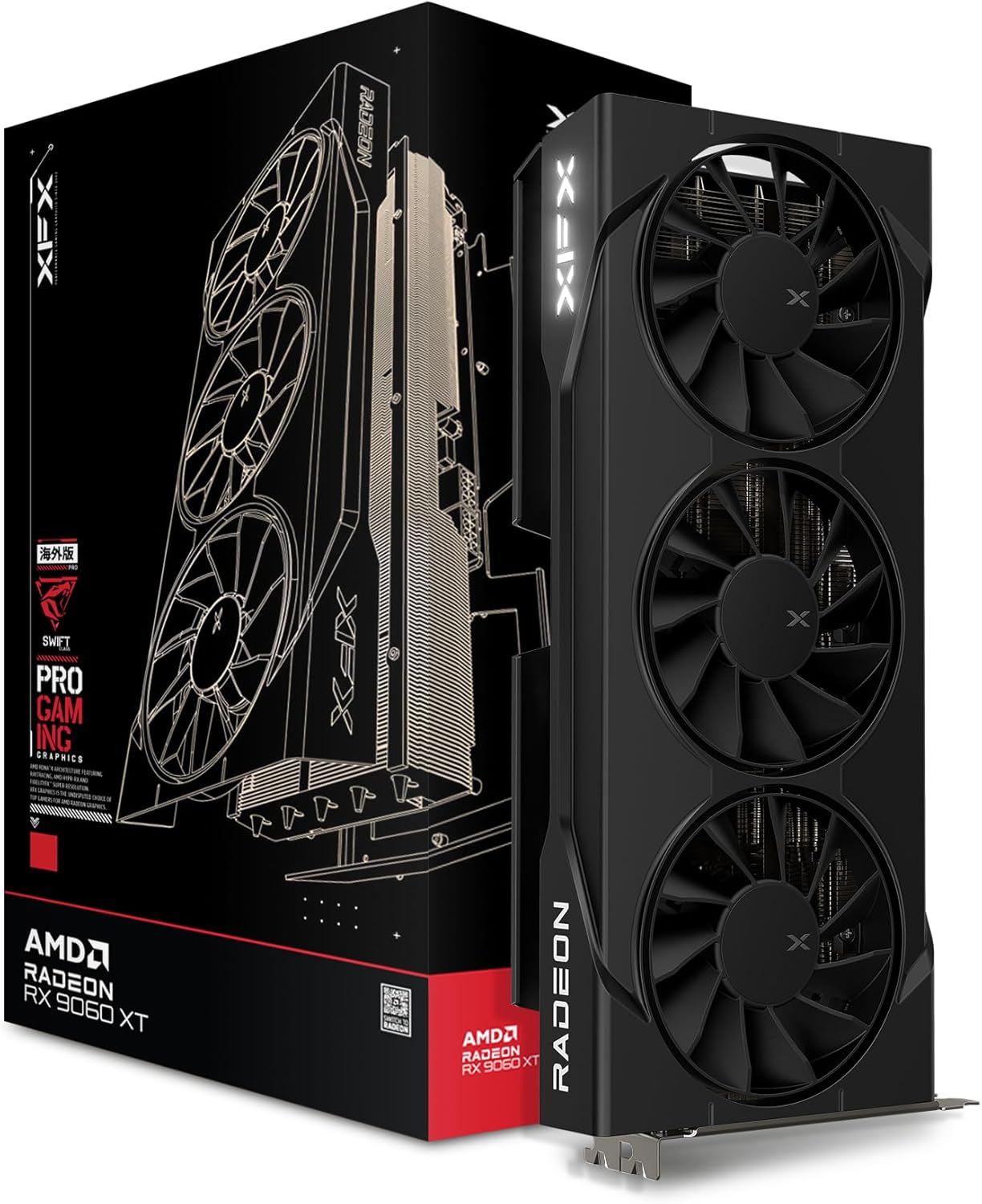
#8. XFX Swift RX 9060 XT
Boost Clock
GDDR6 Memory
Sweet Spot
The XFX Swift RX 9060 XT OC hits a 3320 MHz boost clock with 16GB of GDDR6, giving you excellent 1440p gaming and solid 4K entry performance on RDNA 4. The triple-fan SWFT cooler runs cool and quiet for this class, and the 3-year manufacturer warranty adds real peace of mind at this price tier.
The honest trade-off: this is a step below the RX 9070 series in raw compute, so expect to dial back settings at 4K in the heaviest titles. It’s an outstanding choice for 1440p gamers who want modern RDNA 4 features and plenty of VRAM without flagship cost; skip it if you’re chasing max 4K frame rates.
Pros
- Great 1440p value
- 16GB VRAM at this tier
- 3320 MHz factory OC
Cons
- Not a true 4K card
- Only 2 DisplayPorts
- Below 9070 performance
Specifications
#9. ASRock RX 7700 XT Challenger
GDDR6 Memory
Infinity Cache
Gaming Focus
The ASRock RX 7700 XT Challenger OC gives you 12GB of GDDR6 on a 192-bit bus with 48MB of Infinity Cache, a combination that handles 1440p gaming comfortably and even dips into 4K at reduced settings. The dual-fan Striped Ring cooler with 0dB silent mode keeps things quiet, and modern DisplayPort 2.1 outputs future-proof your monitor connectivity.
The honest caveat: this is previous-gen RDNA 3 silicon, so it lacks the efficiency and AI features of RDNA 4 cards at similar prices, and it needs dual 8-pin power connectors. It’s a solid pick for 1440p gamers who find it discounted; if you’re buying at RDNA 4 prices, step up to the 9070 series instead.
Pros
- 12GB VRAM for 1440p
- Quiet dual-fan cooling
- DisplayPort 2.1 outputs
Cons
- Previous-gen RDNA 3
- Dual 8-pin required
- Weaker 4K performance
Specifications
#10. ASRock RX 7600 Challenger Pro
PSU Friendly
32MB Cache
Silent Mode
The ASRock RX 7600 Challenger Pro OC is a sensible budget card: a 2695 MHz boost clock, 32MB Infinity Cache, and a triple-fan cooler that stays quiet thanks to 0dB silent mode at idle. With just a single 8-pin connector and a 550W PSU recommendation, it slots into modest builds without upgrading your power supply.
The honest limitation is the 8GB of VRAM on a 128-bit bus, which constrains texture-heavy titles at 1440p and above, and PCIe 4.0 x8 bandwidth is modest. It’s a great fit for 1080p gamers upgrading older systems on a budget; skip it if you want RDNA 4 features or future-proof VRAM.
Pros
- Low power requirements
- Quiet triple-fan cooling
- Affordable entry point
Cons
- Only 8GB VRAM
- Narrow 128-bit bus
- Previous-gen RDNA 3
Specifications
Finding the AMD Graphics Card That Actually Fits Your Build
A new GPU is one of the most impactful upgrades you can make to a PC, and AMD’s current lineup offers strong options across a wide range of needs. But buying the “best” card on paper doesn’t always mean buying the best card for you. Resolution, case size, power supply, and even the games you play all shape which card makes sense. A little homework now saves you from buyer’s remorse later.
The Specs That Separate a Great Card From a Costly Mistake
- Match the card to your monitor. The biggest mistake shoppers make is overbuying or underbuying for their display. A card that crushes 1440p may be overkill for 1080p and underwhelming at 4K, so start with your resolution and refresh rate. Our buyer’s guide explains how to match a GPU to your monitor before you spend a dime.
- Check your power supply. Higher-tier AMD cards can demand serious wattage and specific power connectors. Confirm your PSU has the headroom and cables before you click buy, not after.
- Measure your case. Modern GPUs keep getting longer and thicker. Verify clearance for length, width, and slot count so your new card actually fits inside your build.
- Look beyond raw framerate. Features like upscaling, ray tracing performance, and video encoding quality vary across AMD’s lineup. If you stream or care about visual fidelity, weigh these alongside pure speed.
- Mind VRAM for the long haul. Memory capacity increasingly matters as games and creative apps demand more. A card with generous VRAM tends to age better than one that’s slightly faster today.
- Factor in cooling and noise. Different board partners use different cooler designs on the same chip. Reviews that measure thermals and fan noise are worth your time.
Traps That Catch GPU Shoppers Every Season
- Chasing last-gen hype. Older cards still carry lingering reputations, but pricing shifts fast. Compare current-generation options before defaulting to a previous one based on old reviews.
- Ignoring CPU and system balance. A top-tier GPU paired with an aging processor can leave performance on the table. Make sure the rest of your build won’t bottleneck your investment.
- Buying on brand loyalty alone. Two cards with the same chip can differ meaningfully in cooling, warranty, and software experience. Read reviews of the specific model, not just the chip inside it.
Take stock of your whole system first, then pick the card that fits it — that’s how you end up happy instead of second-guessing.
Your Next AMD GPU Awaits
The ASUS Prime RX 9070 XT stands out as the overall champion, ideal for gamers who want premium cooling and dual-BIOS flexibility. The ASRock Steel Legend suits builders craving style and sturdiness, while the XFX Swift cards deliver straightforward value. Creators and AI tinkerers should eye the ASRock AI PRO R9700 Creator with its 32GB of memory, and budget-conscious players will be happy with the RX 7700 XT or RX 7600 Challenger Pro.
No matter which camp you fall into, every card on this list earns its spot — just match the pick to your resolution, workload, and case clearance. Ready to pull the trigger? Tap the buttons above to check current availability before stock shifts.
Final 3 Picks: Overall Pick, 4K Performance, and Seller Pick
Ready to decide? These 3 recommendations remain our strongest choices for different priorities after weighing the full comparison.
ASUS Prime RX 9070 XT OC
- 3030 MHz OC boost clock
- Axial-tech triple fans
- Dual BIOS switch
ASRock RX 9070 XT Challenger
- RDNA 4 architecture
- 2970 MHz boost clock
- Triple fan 0dB cooling
XFX Swift RX 9070 XT
- RX 9070 XT chipset
- 2970 MHz boost clock
- Triple fan SWFT cooling