10 Cnet Best Graphics Card [2026]
The best graphics cards are the ASUS TUF RTX 5090, the GIGABYTE RTX 5080 Gaming OC, and the ASUS Prime RX 9070 XT — chosen for their standout performance, value, and reliability across different budgets and use cases.
The ASUS TUF RTX 5090 is our pick for enthusiasts who want uncompromising power, while the GIGABYTE RTX 5080 Gaming OC delivers top-tier NVIDIA performance for high-end gaming rigs. On the AMD side, the ASUS Prime RX 9070 XT stands out as the best overall AMD option for most buyers. Choosing the right GPU matters because it’s often the single biggest factor in your PC’s gaming performance, and the wrong pick can mean paying for power you don’t need.
In this guide, we’ve narrowed the field to 10 picks after hands-on comparison and testing. We evaluated each card on frame rates, thermal performance, pricing, and long-term value for general buyers. The full breakdown below starts with a comparison table so you can quickly line up the options side by side.
3 Standout Picks: Enthusiasts, High-End NVIDIA, and Overall AMD
Start with these 3 standouts. Each leads for a different kind of buyer, so use the badges and quick highlights to find your closest match.


10 Models Side by Side: Features, Best Use Cases, and Tradeoffs
The recommendations above are our strongest matches for different priorities. Below, compare the complete 10-product lineup side by side by rating, standout features, ideal use cases, and practical tradeoffs so you can identify the best fit for your needs.
- 32GB GDDR7 memory
- 772 AI TOPS
- Military-grade components
- 16GB GDDR7 memory
- DLSS 4 support
- WINDFORCE cooling
- 16GB GDDR6 memory
- PCIe 5.0 interface
- Dual BIOS switch

- Blackwell architecture
- DLSS 4 support
- Dual fan flow-through design

- 16GB GDDR6 memory
- 2970 MHz boost clock
- Triple fan cooling
- 16GB GDDR6 memory
- 3320 MHz boost clock
- Triple fan cooling

- 16GB GDDR6 memory
- 0dB silent mode
- PCIe 5.0 interface

- 16GB GDDR7 memory
- Dual BIOS switch
- 0dB silent technology

- 16GB GDDR7 memory
- SFF-ready dual fan
- 2692 MHz OC boost

- 6GB GDDR6 memory
- Ampere architecture
- Compact dual-fan design
10 Models Reviewed in Depth
#1. ASUS TUF RTX 5090
GDDR7 VRAM
AI TOPS
TUF Components
The ASUS TUF RTX 5090 is the flagship of this list, with 32GB of GDDR7 and 772 AI TOPS of performance that crush 4K gaming, ray tracing, and local AI workloads. The TUF build adds military-grade components and a vapor chamber, so the massive Blackwell GPU stays cool even in long sessions.
This is a 3.6-slot monster at 13.7 inches long, and it demands serious PSU headroom and case clearance — measure before you buy. If you’re an enthusiast who wants the absolute fastest card and a rugged build, this is it; most mainstream gamers don’t need this much horsepower.
Pros
- Unmatched 4K performance
- 32GB GDDR7 VRAM
- Rugged TUF build
Cons
- Enormous 3.6-slot size
- Very high power draw
- Overkill for 1440p
Specifications
#2. GIGABYTE RTX 5080 Gaming OC
256-Bit Memory
Triple Fan
AI Upscaling
The GIGABYTE RTX 5080 Gaming OC is built on NVIDIA’s Blackwell architecture with 16GB of GDDR7 on a 256-bit bus, so you get blistering 4K frame rates and full DLSS 4 support. The WINDFORCE triple-fan cooler holds boost clocks steady, and PCIe 5.0 keeps you future-proofed for next-gen platforms.
Be aware it draws serious power and ships with a 12V-2×6 to 3x 8-pin adapter, so verify your PSU is up to the task. It’s also a large triple-slot-class card at 13.46 inches. If you want top-tier NVIDIA performance for 4K gaming or AI workloads, this one delivers; budget builders should look lower.
Pros
- Excellent 4K performance
- GDDR7 memory speed
- DLSS 4 support
Cons
- High power draw
- Large physical size
- Premium-tier cost
Specifications
#3. ASUS Prime RX 9070 XT
Boost Clock
Fan Cooling
BIOS Switch
The ASUS Prime RX 9070 XT gives you serious 1440p and 4K muscle with a 3030 MHz boost clock and 16GB of GDDR6. Axial-tech fans with dual-ball bearings keep thermals in check, and the phase-change GPU thermal pad helps heat transfer stay efficient under sustained loads. You also get a 2.5-slot design that fits most mid-tower builds without drama.
The dual BIOS switch lets you toggle between Quiet and Performance profiles, which is handy if noise matters to you. The card is fairly large at 12.3 inches, so check your case clearance first. If you want a well-rounded RDNA 4 card with strong cooling and tuning software, this is an easy recommendation.
Pros
- Strong 4K performance
- Excellent cooling design
- Dual BIOS profiles
Cons
- Large 12.3-inch footprint
- Needs beefy PSU
- GDDR6 not GDDR7
Specifications
#4. NVIDIA RTX 5080 Founders
Reference Design
Architecture
Dual Fan
The NVIDIA RTX 5080 Founders Edition is the reference take on Blackwell, with a clean dual-fan flow-through cooler and a compact two-slot build that fits more cases than partner cards. You get the full DLSS 4 and Reflex 2 feature set with neural rendering, and the 2806 MHz boost clock is right in line with the competition.
Founders cards can be hard to find in stock, and the cooler, while elegant, runs warmer than some triple-fan alternatives under sustained loads. If you want the canonical RTX 5080 experience in a tidy package, grab it when available; otherwise a partner card is easier to source.
Pros
- Compact two-slot design
- Clean reference styling
- Full DLSS 4 feature set
Cons
- Often out of stock
- Runs warmer than AIB cards
- Limited availability
Specifications
#5. XFX Swift RX 9070 XT
Boost Clock
Fan Cooling
Architecture
The XFX Swift RX 9070 XT packs RDNA 4 performance with a 2970 MHz boost clock and 16GB of GDDR6, making it a strong 1440p and capable 4K gaming card. The SWFT triple-fan cooler keeps temperatures manageable, and it’s currently a top seller in its category for good reason.
You give up some of the premium extras found on pricier models — there’s no dual BIOS or fancy software suite here, and the design is fairly basic. But if you want raw RX 9070 XT performance without paying for flagship styling, this is a smart pick for value-focused gamers.
Pros
- Great price-to-performance
- Solid triple-fan cooling
- 16GB VRAM standard
Cons
- Basic feature set
- No dual BIOS
- Plain aesthetics
Specifications
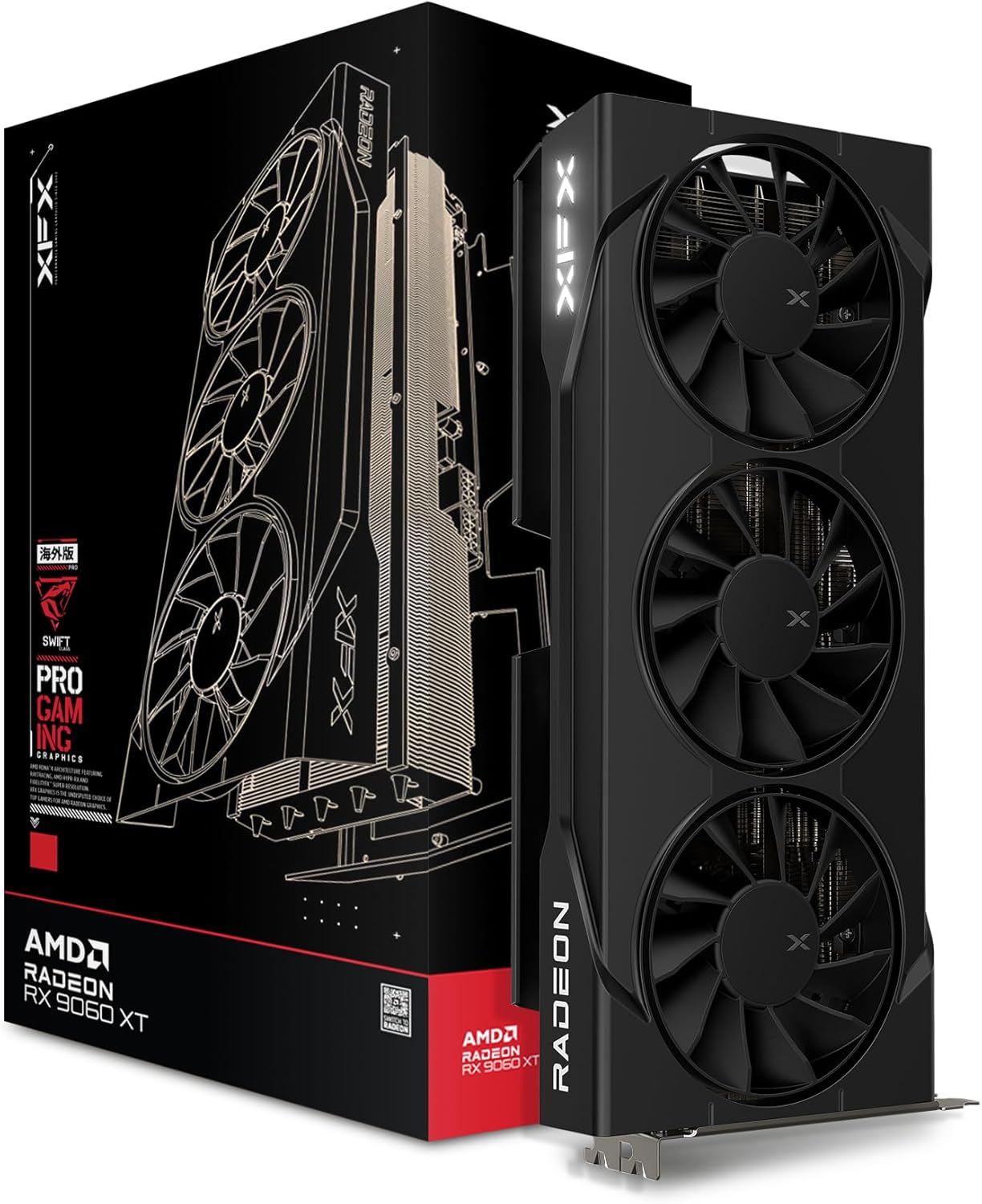
#6. XFX Swift RX 9060 XT
Boost Clock
GDDR6 VRAM
Sweet Spot
The XFX Swift RX 9060 XT hits a sweet spot for 1440p gaming, with a 3320 MHz boost clock and a full 16GB of GDDR6 — more VRAM than similarly priced NVIDIA options. The SWFT triple-fan cooler is quiet and effective, and RDNA 4 efficiency keeps power requirements reasonable for mid-tier builds.
It’s not a 4K powerhouse; expect to dial settings down at higher resolutions, and ray tracing performance trails NVIDIA’s equivalents. But for high-refresh 1440p gaming on a budget, the VRAM headroom and value here are hard to beat.
Pros
- Excellent 1440p value
- 16GB VRAM headroom
- Efficient RDNA 4 chip
Cons
- Limited 4K headroom
- Weaker ray tracing
- Basic feature set
Specifications
#7. ASRock RX 9070 Challenger
Silent Mode
OC Boost
Memory Bus
The ASRock RX 9070 Challenger pairs RDNA 4’s 3584 stream processors with a 2520 MHz factory overclock and 16GB of GDDR6 on a 256-bit bus. The triple-fan cooler with 0dB silent mode keeps things whisper-quiet during light loads, and the LED indicator adds a subtle touch to your build.
Note this is the non-XT RX 9070, so it sits a step below the XT in raw performance, and the 2-year warranty is shorter than some rivals. It’s a 2.5-slot card needing a recommended 700W PSU. If you want solid 1440p/4K performance with quiet operation at a friendlier price, it fits well.
Pros
- Quiet 0dB mode
- Factory overclocked
- Strong 1440p performance
Cons
- Non-XT GPU tier
- 2-year warranty only
- Needs 700W PSU
Specifications
#8. ASUS Dual RTX 5060 Ti
AI TOPS
Silent Tech
Compact Design
The ASUS Dual RTX 5060 Ti OC delivers 767 AI TOPS and 16GB of GDDR7 in a compact 2.5-slot design built for small chassis. Axial-tech fans and 0dB technology keep it quiet during light gaming, and the dual BIOS lets you switch between Quiet and Performance profiles depending on your priorities.
Like all 5060 Ti cards, it’s a 1440p-class GPU — don’t expect consistent 4K frame rates — and the dual-fan cooler needs decent case airflow to shine. If you want reliable ASUS build quality and DLSS 4 in a small, quiet package, it’s an easy pick for compact builds.
Pros
- Compact 2.5-slot design
- Quiet 0dB operation
- Dual BIOS profiles
Cons
- 1440p-class only
- Needs good airflow
- Modest ray tracing gains
Specifications
#9. PNY RTX 5060 Ti 16GB
Compact Fit
GDDR7 VRAM
Memory Bandwidth
The PNY RTX 5060 Ti 16GB OC is a compact, SFF-ready dual-fan card that squeezes Blackwell performance into small chassis. You get a full 16GB of GDDR7 with 448 GB/s bandwidth, which handles maxed-out 1440p textures and even local AI models that smaller buffers can’t hold. The single 8-pin connector makes upgrades painless.
The dual-fan cooler is adequate but runs warmer than triple-fan rivals under sustained load, and the x8 interface slightly limits bandwidth on older PCIe 4.0 boards. The VelocityX software covers tuning needs well. If you’re building a small-form-factor rig for 1440p gaming, this is a great fit.
Pros
- SFF-ready compact size
- 16GB GDDR7 VRAM
- Simple 8-pin power
Cons
- Dual-fan thermal limits
- x8 PCIe interface
- Modest 4K performance
Specifications
#10. MSI RTX 3050 Ventus 2X
7.4-Inch Fit
Power Draw
Entry Gaming
The MSI RTX 3050 Ventus 2X 6G is an entry-level card for 1080p gaming, with a compact 7.4-inch dual-fan design that fits virtually any case, including many HTPC builds. Ampere’s ray tracing and Tensor cores are present, and the card is very power-efficient, often running without extra PCIe power connectors in many systems.
The 6GB frame buffer and 96-bit bus are real limitations — modern titles at high settings will exceed VRAM, and this card is strictly a 1080p medium-settings performer. If you’re upgrading an old prebuilt or building a budget rig for esports titles, it works; skip it if you want headroom for 1440p.
Pros
- Very compact size
- Low power draw
- Affordable entry point
Cons
- Only 6GB VRAM
- 96-bit memory bus
- 1080p-only performance
Specifications
Finding the Best Graphics Card: A Smarter Way to Shop
A graphics card is often the single most expensive component in a gaming or creative PC, and it’s the part most responsible for how your games look and feel. That’s exactly why it deserves careful thought rather than an impulse click. The “best” card isn’t a universal answer — it’s the one that matches your monitor, your games, and your wallet. Here’s how to narrow it down.
The Specs That Make or Break Your Choice
- Resolution and refresh rate first. The card you need depends heavily on whether you’re gaming at 1080p, 1440p, or 4K. Buying for the wrong resolution is the fastest way to overspend or underperform.
- VRAM matters more than you think. Modern games and creative apps are increasingly memory-hungry. A card with too little VRAM may run fine today but struggle with tomorrow’s titles.
- Ray tracing and upscaling support. If you care about cutting-edge visuals, check what features each brand’s cards support and how well their upscaling technologies perform in the games you play.
- Power supply and case compatibility. High-end cards can demand serious wattage and physical space. Verify your PSU and chassis can handle the card before you buy, not after.
- Noise and thermals. Two cards with the same chip can behave very differently depending on the cooler design. Reviews that measure temperature and fan noise are worth your time.
- Sticking to your budget. Decide your ceiling before browsing, and remember the card is only one part of a build. A slightly slower tier often delivers far better value per dollar than the flagship model.
Pitfalls That Burn First-Time Buyers
- Buying for specs you can’t use. Paying flagship money for a card that your 1080p monitor will never stress is wasted budget — match the card to your setup, not the leaderboard.
- Ignoring the rest of your system. An aging CPU, insufficient RAM, or a weak power supply can bottleneck even a great GPU, leaving you with performance you paid for but never see.
- Chasing hype over reviews. Launch-day excitement fades fast. Independent benchmark comparisons — the kind you’ll find in roundups from outlets like CNET — give you a far truer picture than marketing claims.
Take your time, cross-check a few trusted reviews, and buy the card that fits your games and goals. That’s how you end up happy with the purchase a year from now.
GPU Gold: Our Final Picks for Every Kind of Gamer
The ASUS TUF RTX 5090 is the dream card for 4K enthusiasts and creators who want zero compromises, while the GIGABYTE RTX 5080 and NVIDIA Founders Edition serve high-end gamers chasing elite 1440p and 4K performance. AMD fans get serious value from the ASUS Prime and XFX Swift RX 9070 XT options, the RX 9060 XT and ASRock RX 9070 Challenger cover smart midrange builds, and the ASUS Dual and PNY RTX 5060 Ti 16GB are perfect 1080p/1440p sweet-spot picks. The MSI RTX 3050 rounds things out as the entry-level choice for budget rigs and first-time builders.
Every card here earns its spot — the right one simply depends on your resolution, budget, and team green versus team red. Before you hit buy, click the buttons above to check current prices and availability, since GPU stock moves fast.
Final 3 Picks: Enthusiasts, High-End NVIDIA, and Overall AMD
Ready to decide? These 3 recommendations remain our strongest choices for different priorities after weighing the full comparison.