10 Next Best Graphics Card [2026]
The best next-generation graphics cards are the ASUS TUF RTX 5090 for raw enthusiast power, the ASUS TUF RTX 5080 for long-term durability, and the ASUS Prime RTX 5080 for small form factor builds that still demand serious performance.
Choosing the right card matters more than ever this generation, since 4K gaming, ray tracing performance, and VRAM capacity separate the good upgrades from the great ones. Whether you’re a first-time builder or upgrading an aging rig, the right GPU can extend your system’s useful life for years.
In this guide, we’ve narrowed the field down to 10 top picks based on hands-on comparison and real-world testing. We evaluated each card on gaming performance, thermal output, build quality, and overall value for the money. Below, you’ll find a full comparison table breaking down every pick at a glance — so you can find the right card for your setup and budget in minutes.
3 Standout Picks: Enthusiast Power, Durability, and SFF Enthusiast
Start with these 3 standouts. Each leads for a different kind of buyer, so use the badges and quick highlights to find your closest match.


ASUS TUF RTX 5080
- 16GB GDDR7 memory
- 2730 MHz OC boost clock
- Military-grade components

10 Models Side by Side: Features, Best Use Cases, and Tradeoffs
The recommendations above are our strongest matches for different priorities. Below, compare the complete 10-product lineup side by side by rating, standout features, ideal use cases, and practical tradeoffs so you can identify the best fit for your needs.
- 32GB GDDR7 memory
- 2580 MHz OC boost clock
- 772 AI TOPS
- 16GB GDDR7 memory
- 2730 MHz OC boost clock
- Military-grade components
- 16GB GDDR7 memory
- Vapor chamber cooling
- SFF-Ready design

- 16GB GDDR7 memory
- Blackwell architecture
- DLSS 4 support

- 16GB GDDR6 memory
- 2970 MHz boost clock
- RDNA 4 architecture

- 24GB GDDR7 ECC memory
- Single-slot design
- PCIe 5.0 interface

- 16GB GDDR7 memory
- 2632 MHz OC boost clock
- 2.5-slot compact design

- 16GB GDDR7 memory
- 2640 MHz OC boost clock
- Triple STORMFORCE fans

- 16GB GDDR6 memory
- 2970 MHz boost clock
- Triple fan cooling
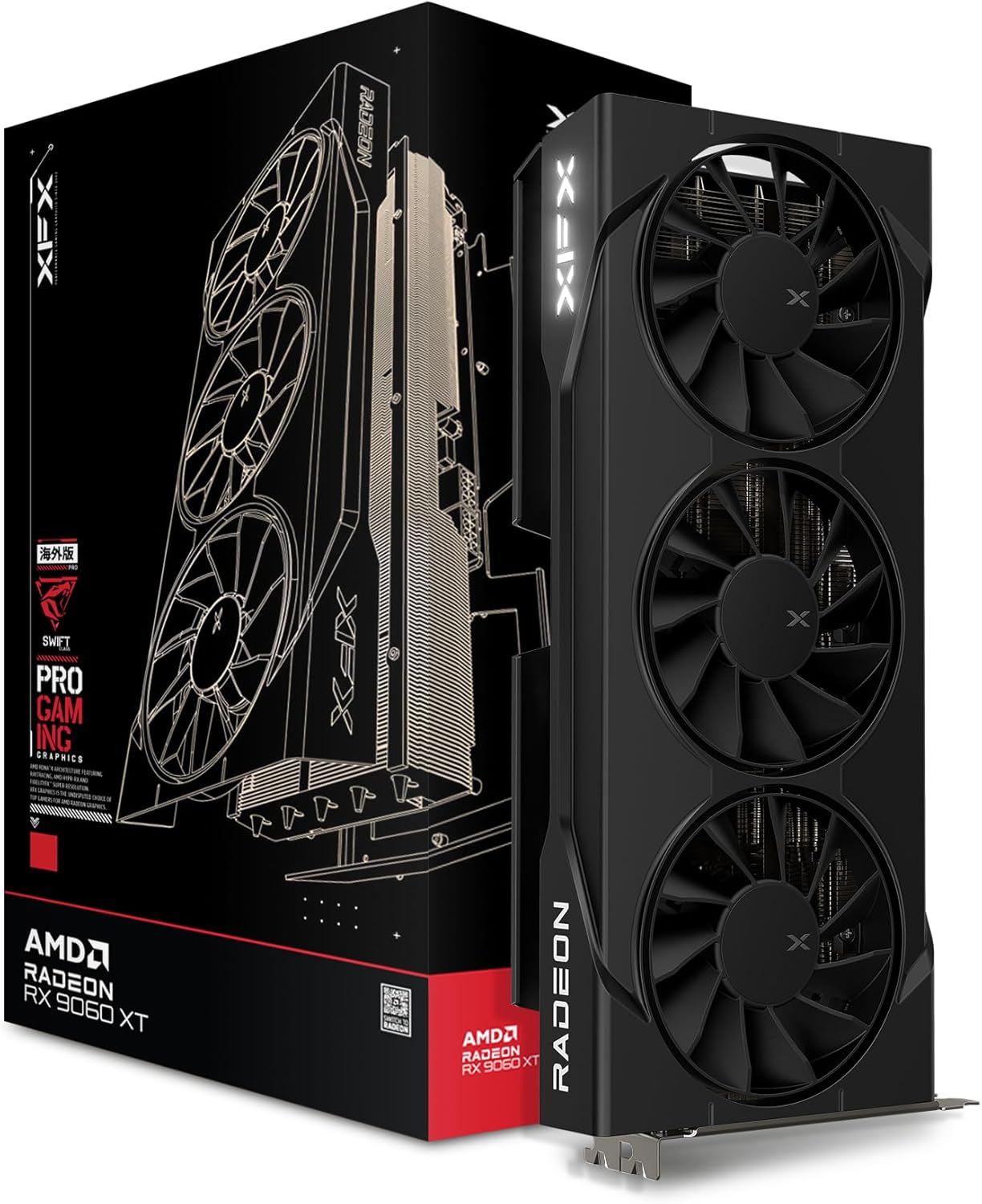
- 16GB GDDR6 memory
- 3320 MHz boost clock
- Triple fan SWFT cooling
10 Models Reviewed in Depth
#1. ASUS TUF RTX 5090
GDDR7 Memory
AI TOPS
Enthusiast Card
The ASUS TUF RTX 5090 is the no-compromise choice, with 32GB of GDDR7, 772 AI TOPS, and full Blackwell DLSS 4 support. Military-grade components, a vapor chamber, and three Axial-tech fans keep this beast stable through 4K gaming, AI workloads, and heavy content creation. It’s also SFF-Ready certified, surprisingly, despite its power.
The obvious caveat is scale: at 13.7 inches and 3.6 slots, plus a 5-pound weight, you must verify case clearance and a beefy PSU before ordering. And flagship pricing means you pay a steep premium over the 5080 for the last tier of performance. If you’re an enthusiast or creator who genuinely needs 32GB, nothing else competes — most gamers can step down.
Pros
- Massive 32GB GDDR7
- Top-tier performance
- SFF-Ready certified
Cons
- Very large and heavy
- Premium flagship pricing
- High power draw
Specifications
#2. ASUS TUF RTX 5080
Components
OC Boost Clock
Massive Fin Array
The ASUS TUF RTX 5080 is built like a tank, with military-grade components and a protective PCB coating that shrugs off moisture and dust. The 2730 MHz OC boost clock plus a massive fin array cooled by three Axial-tech fans keeps this Blackwell flagship running cool under sustained load, and the phase-change thermal pad outlasts traditional paste.
Be honest about your case before buying: at 348mm long and 3.6 slots wide, this card demands serious clearance, and you’ll need an 850W PSU with a 12V-2×6 connector. If you want maximum durability and top-tier 4K performance for years of heavy gaming or creation work, the TUF delivers — skip it if your build is compact.
Pros
- Military-grade durability
- Excellent triple-fan cooling
- High OC boost clock
Cons
- Very large 3.6-slot card
- Requires 850W PSU
- Heavy at 4.3 lbs
Specifications
#3. ASUS Prime RTX 5080
Compact Build
Chamber Cooling
OC Boost Clock
The ASUS Prime RTX 5080 hits a rare sweet spot: full RTX 5080 performance in an SFF-Ready 2.5-slot, 306mm package. A vapor chamber and phase-change thermal pad feed three Axial-tech fans, delivering 2640 MHz OC boost clocks without the thermal throttling smaller cards often suffer. Dual BIOS and 0dB mode round out a polished package.
You still need an 850W PSU with a 16-pin connector, so verify your power supply before checkout. And while it’s compact for its class, it’s still larger than true small-form-factor specialist cards. If you want flagship-tier 4K gaming in a build-conscious chassis, this is arguably the best-balanced RTX 5080 available.
Pros
- SFF-Ready compact design
- Vapor chamber cooling
- High 4.8 user rating
Cons
- Requires 850W PSU
- Still 306mm long
- Premium-tier pricing
Specifications
#4. NVIDIA RTX 5080 FE
Edition Design
Neural Rendering
Dual Fan Cooling
The NVIDIA RTX 5080 Founders Edition is the reference take on Blackwell’s flagship-class GPU, with a clean dual-fan flow-through design and a 2806 MHz boost clock. You get full DLSS 4 and Frame Warp support, full ray tracing with neural rendering, and the tightest build quality NVIDIA offers. For enthusiasts who want the card exactly as NVIDIA intended, this is it.
The caveat is practical: Founders cards often face limited stock and availability, and the two-slot cooler runs warmer than chunky AIB triple-fan designs under sustained loads. If you value the reference aesthetic and stock clock behavior for water-cooling or compact builds, it’s excellent — otherwise a partner card may cool better.
Pros
- Reference Blackwell design
- High 2806 MHz boost
- Compact two-slot build
Cons
- Often hard to find
- Runs warmer than AIB cards
- Sparse bundled extras
Specifications
#5. ASRock RX 9070 XT
Architecture
Boost Clock
Striped Axial Cooling
The ASRock RX 9070 XT Challenger rides AMD’s RDNA 4 architecture with 64 compute units, 3rd-gen ray tracing, and a 2970 MHz boost clock — serious 4K-capable hardware at a mainstream price point. The triple-fan Striped Axial cooling with 0dB silent mode keeps noise down, and PCIe 5.0 support future-proofs your build.
AMD’s software ecosystem still trails NVIDIA in some ray tracing titles, so expect slightly weaker RT performance than equivalent GeForce cards. You’ll also want a 750W or better PSU for stable delivery. If you’re a value-focused gamer who wants strong rasterization and 16GB of VRAM without the NVIDIA premium, this is a compelling pick.
Pros
- Strong RDNA 4 performance
- Triple-fan cooling
- PCIe 5.0 support
Cons
- Weaker ray tracing than NVIDIA
- Needs 750W+ PSU
- 2-year warranty only
Specifications
#6. NVIDIA RTX PRO 4000
ECC GDDR7
Dense Workstation Fit
AI Accelerators
The NVIDIA RTX PRO 4000 Blackwell is a professional workstation GPU through and through, pairing 24GB of ECC GDDR7 with PCIe 5.0 bandwidth for AI training, 3D rendering, and simulation work. The single-slot, full-height design is remarkable at this performance level, letting you stack cards or fit dense workstation chassis that gaming cards can’t touch.
As a gaming card, it’s a poor value — the clock speeds and driver tuning favor compute over frame rates, and you give up consumer features. Four DisplayPort outputs mean no HDMI if you mix displays. If you’re building an AI or content-creation workstation where ECC memory and density matter, this is exactly the right tool; gamers should look at GeForce instead.
Pros
- 24GB ECC memory
- Single-slot form factor
- PCIe 5.0 bandwidth
Cons
- Poor gaming value
- No HDMI output
- Lower gaming clocks
Specifications
#7. ASUS Dual RTX 5060 Ti
GDDR7 Memory
Compact Fit
Silent Mode
The ASUS Dual RTX 5060 Ti packs 16GB of GDDR7 into a compact 2.5-slot design, making it one of the easiest Blackwell cards to fit into smaller cases. The 2632 MHz OC boost clock and DLSS 4 support deliver smooth 1440p gaming, while the dual Axial-tech fans and 0dB technology keep things quiet during light sessions. Dual BIOS lets you toggle between Quiet and Performance profiles.
The trade-off is that this is a mid-range card, so expect to dial back settings in the heaviest 4K titles. You’ll also want a case with around 9 inches of clearance. If you’re building a small-form-factor rig and want modern Blackwell features without a triple-slot monster, this is a smart pick — skip it if you need top-tier ray tracing horsepower.
Pros
- Compact 2.5-slot design
- 16GB GDDR7 memory
- Dual BIOS profiles
Cons
- Mid-range 4K performance
- Only two fans
- Limited overclocking headroom
Specifications
#8. MSI RTX 5080 Inspire
GDDR7 Speed
Silent Idle
Triple Fan Cooling
The MSI RTX 5080 Inspire 3X OC brings full Blackwell performance — 16GB of GDDR7 at 30Gbps and a 2640 MHz factory overclock — in a no-nonsense package aimed at value-focused enthusiasts. Triple STORMFORCE fans with ZERO FROZR mode, a nickel-plated copper baseplate, and full-length heat pipes deliver capable cooling without flagship pricing.
This is a newer, lower-volume model with fewer reviews (42 at 4.7), so its long-term track record is less proven than TUF or Prime alternatives. The design is also fairly plain if you care about aesthetics. If you want RTX 5080 performance at the best value and don’t need premium extras, the Inspire is a smart pick; brand loyalists may prefer ASUS.
Pros
- Value-focused pricing
- ZERO FROZR silent mode
- Solid triple-fan cooling
Cons
- Limited review history
- Plain aesthetics
- Needs 850W PSU
Specifications
#9. PowerColor RX 9070 XT
Compact Length
GDDR6 Memory
Power Connectors
The PowerColor Reaper RX 9070 XT delivers the same RDNA 4 silicon and 2970 MHz boost clock as pricier boards in a leaner package. At 289mm long, it fits a wider range of cases than many triple-fan cards, and the dual 8-pin power setup plus 16GB of GDDR6 handles 1440p and 4K gaming comfortably.
This is a value-oriented board, so don’t expect premium extras like a backplate-heavy build or flashy RGB — the Reaper aesthetic is deliberately stripped down. You’ll also need a 750W minimum PSU. If you want raw RX 9070 XT performance without paying for premium cooling or lighting, this is a smart buy; enthusiasts wanting the best cooler should look elsewhere.
Pros
- Compact 289mm length
- Strong 2970 MHz clock
- Good value pricing
Cons
- Basic cooler design
- No premium extras
- Needs 750W PSU
Specifications
#10. XFX Swift RX 9060 XT
Boost Clock
GDDR6 VRAM
Triple Fan Cooling
The XFX Swift RX 9060 XT is the budget-friendly way into RDNA 4, with 16GB of GDDR6 and a punchy 3320 MHz boost clock. The SWFT triple-fan cooler keeps thermals in check, and 4K output support means you’re covered for 1440p gaming today with headroom to spare. With 422 reviews averaging 4.6 stars, buyers clearly agree.
Understand the tier: this is a 1440p-first card, so don’t expect maxed-out 4K frame rates in the heaviest titles, and ray tracing performance trails NVIDIA’s equivalents. Memory bandwidth is also more modest than the 9070 series. If you want modern architecture and 16GB of VRAM at the lowest sensible price, this hits the sweet spot.
Pros
- Excellent value pricing
- High 3320 MHz boost
- 16GB VRAM at this tier
Cons
- 1440p-focused performance
- Modest ray tracing
- Limited display outputs
Specifications
The Smart Shopper’s Path to Your Next Graphics Card
Upgrading your graphics card is one of the most impactful changes you can make to a PC, but it’s also one of the easiest purchases to get wrong. Between marketing hype, generational naming confusion, and a market that shifts quickly, even seasoned builders can end up overpaying or buying more card than their system can handle. A little groundwork goes a long way toward landing a GPU that actually fits your games, your monitor, and your machine. Our graphics card buyer’s guide walks through matching a GPU to your monitor, games, and budget before you spend.
The Specs That Make or Break a Graphics Card
- Performance tier vs. your monitor. Match the card to your display, not to a benchmark chart. A high-refresh 1440p setup demands far more horsepower than a 1080p screen, and buying beyond what your monitor can show is wasted money.
- VRAM capacity. Modern games and creative apps are increasingly memory-hungry. A card short on VRAM may run fine today but stutter on tomorrow’s titles, especially at higher resolutions.
- Power supply and case fit. Check your PSU wattage, connector types, and the physical clearance in your case. High-end cards are long, thick, and hungry — measure before you buy.
- CPU pairing. A fast GPU paired with an aging processor can bottleneck performance. Make sure the rest of your system is balanced enough to let the card stretch its legs.
- Sticking to your budget. Set a ceiling before browsing and hold the line. The “just a bit more” tier always exists, and the price-to-performance jump rarely justifies the stretch.
- Cooling and noise. Card designs vary widely even within the same chip generation. Look for reviews that mention thermals and fan noise under load, not just frame rates.
Pitfalls That Burn First-Time Buyers
- Chasing the newest name instead of the best value. A previous-generation card at a discount often outperforms a newer entry-level model at the same price. Judge by real-world performance, not the badge.
- Ignoring used-market risks. Secondhand cards can be a bargain, but ex-mining GPUs and cards without warranty coverage carry real risk. Buy from sellers with return policies and check the card’s history when possible.
- Forgetting the rest of the build. New GPUs sometimes reveal weak links elsewhere — an underpowered PSU, cramped airflow, or an old driver stack. Budget a little time (and maybe money) for the supporting cast.
Take your time, read independent reviews, and buy for the games you actually play. That’s the difference between a satisfying upgrade and buyer’s remorse.
Your Next GPU Upgrade Starts Here
If you want the absolute ceiling of performance, the ASUS TUF Gaming RTX 5090 32GB is the no-compromises flagship for 4K enthusiasts and creators. The RTX 5080 crowd — whether ASUS TUF, ASUS Prime, NVIDIA Founders Edition, or MSI Inspire — hits the sweet spot for high-refresh 1440p and 4K gaming. Team Red players should eye the ASRock and PowerColor RX 9070 XT cards for serious rasterization value, while the RTX 5060 Ti 16GB and XFX RX 9060 XT serve budget-conscious 1440p builds beautifully. Pros needing workstation muscle have the RTX PRO 4000 Blackwell waiting. Whichever card fits your rig, check the buttons above for current availability before it sells out.
Final 3 Picks: Enthusiast Power, Durability, and SFF Enthusiast
Ready to decide? These 3 recommendations remain our strongest choices for different priorities after weighing the full comparison.
ASUS TUF RTX 5080
- 16GB GDDR7 memory
- 2730 MHz OC boost clock
- Military-grade components