10 What Is The Best Amd Graphics Card Right Now [2026]
The best AMD graphics card right now is the ASUS Prime RX 9070 XT OC as the best overall pick, with the GIGABYTE RX 9070 XT Gaming OC standing out for 4K gaming and the ASRock RX 9070 XT Challenger offering the best 4K value.
AMD’s current lineup delivers strong ray tracing performance, competitive frame rates at 1440p and 4K, and solid price-to-performance for both first-time builders and upgraders. These cards also benefit from mature driver support and features like FSR upscaling, making them a smart buy for modern games. In this guide, we’ve narrowed the field to 10 picks after hands-on comparison of real-world gaming performance, thermals, noise levels, and overall value.
Each card was evaluated on build quality, cooling design, and price-to-performance rather than specs alone. The full comparison table below breaks down how all 10 picks stack up side by side.
3 Standout Picks: Overall Pick, 4K Gaming, and 4K Value
Start with these 3 standouts. Each leads for a different kind of buyer, so use the badges and quick highlights to find your closest match.


GIGABYTE RX 9070 XT Gaming OC
- 16GB GDDR6 memory
- PCIe 5.0 interface
- WINDFORCE cooling

ASRock RX 9070 XT Challenger
- 16GB GDDR6 memory
- RDNA 4 architecture
- Triple fan 0dB cooling
10 Models Side by Side: Features, Best Use Cases, and Tradeoffs
The recommendations above are our strongest matches for different priorities. Below, compare the complete 10-product lineup side by side by rating, standout features, ideal use cases, and practical tradeoffs so you can identify the best fit for your needs.
- 16GB GDDR6 memory
- Dual BIOS switch
- Axial-tech fans
- 16GB GDDR6 memory
- PCIe 5.0 interface
- WINDFORCE cooling
- 16GB GDDR6 memory
- RDNA 4 architecture
- Triple fan 0dB cooling

- 16GB GDDR6 memory
- Compact 2.5-slot design
- 0dB silent technology
- 16GB GDDR6 memory
- RDNA 4 architecture
- Triple fan cooling

- 20GB GDDR6 memory
- RDNA 3 architecture
- USB-C output

- 12GB GDDR6 memory
- White triple fan design
- RDNA 4 architecture

- 12GB GDDR6 memory
- RDNA 4 architecture
- Triple fan cooling

- 8GB GDDR6 memory
- RDNA 3 architecture
- 0dB silent cooling

- 8GB GDDR6 memory
- RDNA 3 architecture
- Dual fan cooling
10 Models Reviewed in Depth
#1. ASUS Prime RX 9070 XT OC
BIOS Switch
Fan Design
Thermal Pad
The ASUS Prime RX 9070 XT OC is arguably the best-rounded AMD card right now, combining 16GB of GDDR6, a 3030 MHz OC boost clock, and PCIe 5.0 in a manageable 2.5-slot design. ASUS’s Axial-tech fans and phase-change thermal pad deliver excellent thermals, while the dual BIOS switch lets you trade quiet vs. performance profiles. It’s the #6 best-seller with an 868-review 4.6-star average.
The caveat is that it’s still a flagship-class card with flagship power requirements — plan for a quality PSU and good airflow. GPU Tweak III makes tuning easy if you want to push further. If you want one AMD card that does 1440p and 4K equally well, this is it; skip if you’re on a strict budget.
Pros
- Top-tier RDNA 4 performance
- Excellent Axial-tech cooling
- Dual BIOS flexibility
Cons
- Demands strong PSU
- Premium-tier pricing
- Large for small cases
Specifications
#2. GIGABYTE RX 9070 XT Gaming OC
Gaming Ready
Hawk Fans
Next-Gen Bandwidth
The GIGABYTE Gaming OC RX 9070 XT is one of the strongest AMD cards you can buy right now, pairing 16GB of GDDR6 with a 3060 MHz boost clock on the RDNA 4 platform. The WINDFORCE cooler with Hawk fans and server-grade thermal gel keeps temperatures in check even during long 4K sessions. With 638 reviews averaging 4.6 stars, buyers clearly agree.
The honest caveat: this is a big, power-hungry card, so you’ll want a robust PSU and a roomy case. RGB lighting won’t be for everyone either. If you want top-tier 4K and high-refresh 1440p performance from AMD, this is a standout pick — skip it if you’re building a compact budget rig.
Pros
- Excellent 4K performance
- Effective WINDFORCE cooling
- PCIe 5.0 ready
Cons
- High power draw
- Large physical footprint
- RGB not for everyone
Specifications
#3. ASRock RX 9070 XT Challenger
RDNA 4 Power
High Refresh
Silent Cooling
The ASRock Challenger RX 9070 XT brings full RDNA 4 flagship performance — 64 compute units, a 2970 MHz boost clock, and 16GB of GDDR6 on a 256-bit bus — at a Challenger price point. Triple striped axial fans with 0dB silent cooling handle thermals well, and you get modern DisplayPort 2.1a and HDMI 2.1b outputs for high-refresh 4K displays. A 4.7-star rating across 189 reviews is encouraging.
The caveat: ASRock recommends a 750W+ power supply, so factor that into your build budget, and the warranty is two years rather than three. If you want 4K-class AMD performance without paying flagship-card premiums, this Challenger hits the sweet spot — skip if your PSU is older or underpowered.
Pros
- Flagship RDNA 4 performance
- Strong value for 4K
- Modern display outputs
Cons
- Needs 750W+ PSU
- Two-year warranty only
- Large triple-fan card
Specifications
#4. ASUS Dual RX 9060 XT
2.5-Slot Fit
GDDR6 Memory
Silent Mode
The ASUS Dual RX 9060 XT packs 16GB of GDDR6 and a 3250 MHz OC boost clock into a compact 2.5-slot, dual-fan design that fits small and mid-tower builds easily. You still get flagship niceties like 0dB silent mode, dual BIOS, and dual-ball fan bearings rated to last twice as long as sleeve designs. A 4.7-star average across 448 reviews backs it up.
The trade-off for the smaller footprint is that two fans move less air than a triple-fan card under sustained load, so expect slightly warmer sustained temps. It’s also limited to two DisplayPort outputs. If you’re building a compact gaming PC without sacrificing VRAM, this is a great fit — skip if you want maximum cooling headroom.
Pros
- Compact 2.5-slot design
- 16GB VRAM retained
- Quiet 0dB operation
Cons
- Dual-fan thermal limits
- Only 2 DisplayPorts
- Midrange performance tier
Specifications
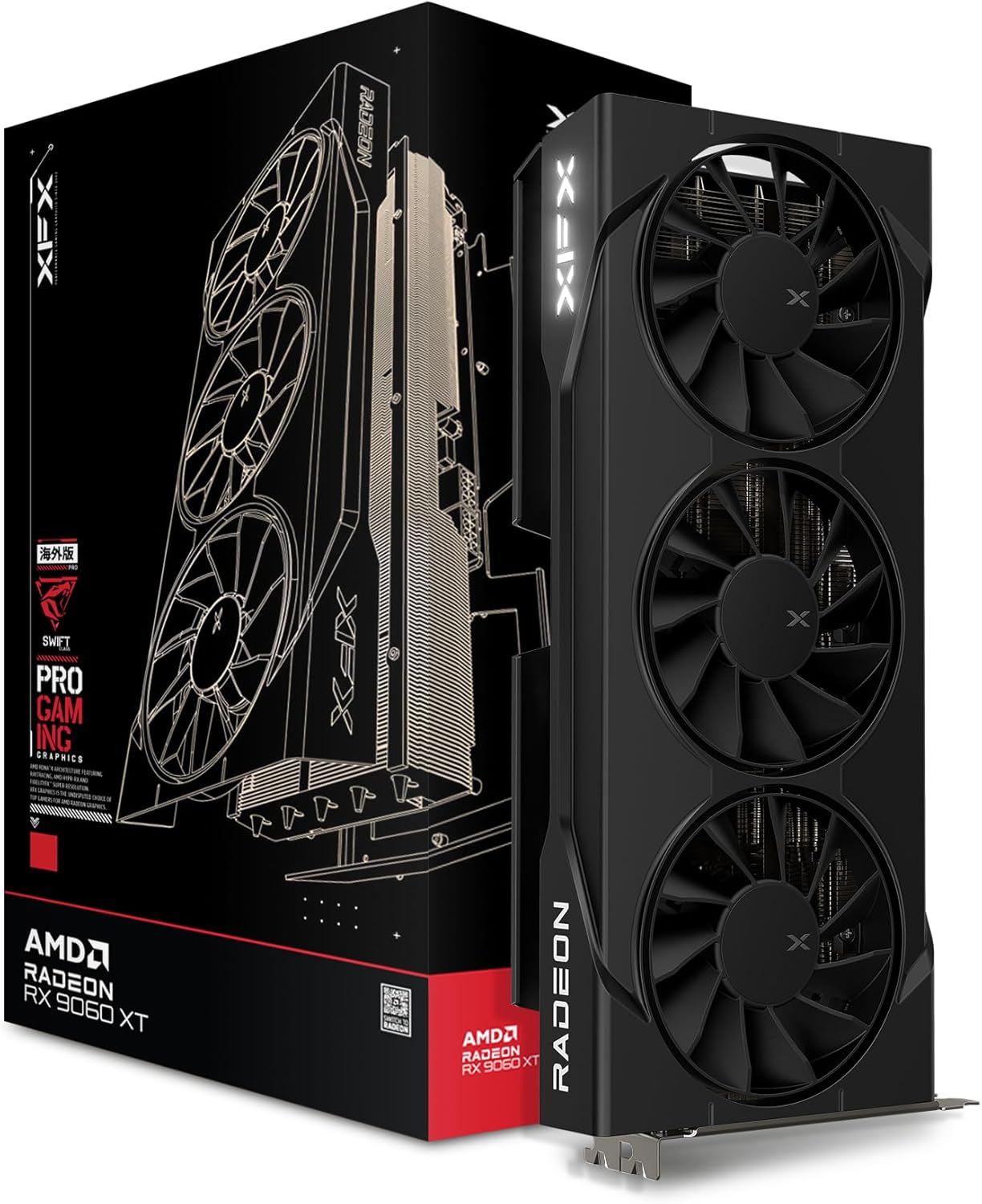
#5. XFX Radeon RX 9060 XT
GDDR6 Memory
Architecture
Fan Cooling
The XFX Swift RX 9060 XT gives you AMD’s latest RDNA 4 architecture with a generous 16GB of GDDR6, which is a lot of VRAM at this tier. The triple-fan cooler keeps the card comfortable under load, and the 3320 MHz boost clock delivers strong 1080p and capable 1440p frame rates. You also get a 3-year warranty and a 4.6-star rating from hundreds of buyers.
The main caveat is that it’s a mainstream-tier card, so expect to dial settings down at 1440p in the heaviest titles rather than maxing everything. If you want the best balance of VRAM, modern features, and value right now, this is an easy recommendation — skip it only if you need 4K-class horsepower.
Pros
- 16GB VRAM at this tier
- Efficient triple-fan cooler
- Latest RDNA 4 architecture
Cons
- Not a 4K-class card
- Mainstream performance tier
- Only 2 DisplayPort outputs
Specifications
#6. Sapphire RX 7900 XT 20GB
GDDR6 VRAM
Memory Bus
Display Output
The Sapphire RX 7900 XT stands out for sheer memory: 20GB of GDDR6 on a 320-bit bus, which makes it excellent for high-resolution textures, heavy modding, and GPU-accelerated creative work. Sapphire’s triple-fan, 3-slot cooler handles the big RDNA 3 die well, and the USB-C output is a nice bonus for VR headsets and modern displays.
The honest trade-offs: this is last-generation RDNA 3 silicon, so it draws more power and lacks RDNA 4’s efficiency and upscaling improvements. The 3-slot footprint also demands a spacious case. If you prioritize maximum VRAM and multi-purpose workloads over cutting-edge architecture, it remains a strong buy — skip if you want the newest generation’s features.
Pros
- Massive 20GB VRAM
- USB-C output included
- Strong creator workloads
Cons
- Previous-gen RDNA 3
- High power draw
- Bulky 3-slot design
Specifications
#7. XFX RX 9070 GRE White
Build Edition
Architecture
GDDR6 Memory
The XFX Swift RX 9070 GRE White is aimed squarely at white-themed builds, offering RDNA 4 performance with a 2790 MHz boost clock and 12GB of GDDR6 in a matching white triple-fan shroud. You get strong 1440p-class performance and the visual cohesion most white builds struggle to find at this tier.
The honest caveats: the 12GB of VRAM sits between the 16GB XT models and 8GB budget cards, which limits 4K texture headroom, and with only 9 reviews the track record is thin compared to established options. If you’re committed to a white aesthetic and want upper-midrange AMD performance, this fits beautifully — skip if VRAM capacity is your priority.
Pros
- White-themed design
- Strong 1440p performance
- Triple fan cooling
Cons
- 12GB VRAM compromise
- Limited review history
- Not full XT performance
Specifications
#8. XFX RX 9070 GRE Swift
Sweet Spot
Fan Cooling
Generation
The XFX Swift RX 9070 GRE delivers RDNA 4 midrange performance with a 2790 MHz boost clock and 12GB of GDDR6, positioning it as a capable 1440p card. The triple-fan Swift cooler provides solid thermal headroom, and XFX backs it with a 3-year warranty. For gamers who find XT cards overkill, this tier makes sense.
The caveats are real, though: 12GB of VRAM limits 4K ambitions, and with just 7 reviews there’s little community validation yet — you’re buying on spec rather than track record. It also trails the 9070 XT models in raw compute. If you want modern RDNA 4 features at a midrange target, it’s reasonable; skip if you want proven, heavily reviewed options.
Pros
- Modern RDNA 4 features
- Solid triple-fan cooling
- 3-year warranty
Cons
- Very few reviews
- 12GB VRAM ceiling
- Trails XT models
Specifications
#9. ASRock RX 7600 Challenger Pro
Gaming Focus
Silent Cooling
Cache 32MB
The ASRock Challenger Pro RX 7600 is a solid 1080p gaming engine, with a 2695 MHz boost clock and 32 RDNA 3 compute units handling ray tracing and AI workloads. The triple-fan cooler with 0dB silent mode keeps things quiet during light use, and the metal backplate adds rigidity. You get four-display support with up to 8K output.
Be honest with yourself about the 8GB of VRAM — it’s fine for 1080p today but will feel tight in newer titles at higher settings. The card is also a large 2.5-slot, 303mm unit, so check your case clearance first. Good for budget-focused 1080p builders; skip if you want headroom for 1440p.
Pros
- Strong 1080p frame rates
- Quiet 0dB cooling mode
- Solid Super Alloy build
Cons
- Only 8GB VRAM
- Large 2.5-slot footprint
- PCIe x8 interface
Specifications
#10. XFX SWFT210 RX 7600
1080p Gaming
Efficiency
Dual Fan
The XFX SWFT210 RX 7600 is a straightforward budget card that gets the essentials right: 8GB of GDDR6, RDNA 3 efficiency, and a 2655 MHz boost clock for smooth 1080p gaming. The dual-fan SWFT cooler is compact and unobtrusive, and the card sips power compared to bigger GPUs, making it easy to pair with modest PSUs.
Be realistic about limits — 8GB of VRAM and midrange compute mean you’ll lower settings in demanding new titles, and ray tracing performance is modest. There’s no frills here, no RGB or premium backplate theatrics. If you want the cheapest credible path to solid 1080p gaming, this is a smart buy; skip if you need 1440p headroom.
Pros
- Affordable entry point
- Power efficient RDNA 3
- Compact dual-fan design
Cons
- Only 8GB VRAM
- Modest ray tracing
- Basic cooler design
Specifications
Finding the AMD Graphics Card That Actually Fits Your Setup
Picking a new AMD graphics card isn’t just about grabbing the biggest number on the box. The right choice depends on your monitor, your games, your power supply, and how long you plan to keep it. Spend a little time matching the card to your real needs, and you’ll avoid paying for performance you’ll never use — or worse, buying something that leaves you wanting more six months in. Our guide to choosing a GPU for gaming walks through matching specs like VRAM and clock speed to the games you play.
The Specs That Make or Break Your Choice
- Resolution and refresh rate first. The single biggest factor is what you’re playing on. A card that flies at 1080p may struggle at 1440p or 4K, so match the GPU tier to your display before anything else.
- VRAM for the long haul. Modern games are increasingly memory-hungry, especially with high-resolution textures. More VRAM buys you future-proofing, while a card that’s light on memory can feel outdated fast.
- Ray tracing and upscaling support. AMD’s current cards handle ray tracing far better than older generations, and features like FSR can dramatically boost frame rates. Make sure the card supports the latest versions of these technologies.
- Power supply compatibility. Check the recommended wattage and required power connectors before you buy. A great card is no good if your PSU can’t feed it, and upgrading both adds cost.
- Case clearance and cooling. Higher-end AMD cards are often physically large. Measure your case and look at cooler designs — a card that runs hot and loud will wear on you daily. If thermals worry you, our tips to improve GPU cooling cover airflow, dust control, and fan setup.
- Sticking to your budget. AMD’s lineup spans entry-level to flagship, and the sweet spot usually sits a tier or two below the top. Mid-range cards often deliver the best performance-per-dollar, so don’t assume the priciest option is the smartest buy.
Pitfalls That Burn First-Time Buyers
- Buying for games you don’t play. If your library is mostly esports titles or older releases, a flagship card is wasted money. Buy for what’s actually in your Steam library.
- Ignoring the rest of your system. An aging CPU, slow RAM, or a dated monitor can bottleneck even a powerful GPU. Make sure the card won’t be held back — or paired with parts that can’t keep up.
- Chasing hype over reviews. Launch-day buzz and brand loyalty are poor guides. Independent benchmarks at your target resolution tell you far more than marketing ever will.
Match the card to your monitor, your games, and your power supply, and you’ll land on an AMD GPU that feels like a genuine upgrade — not an expensive compromise.
The Verdict: Your Next AMD Graphics Card Awaits
For most gamers, the ASUS Prime Radeon RX 9070 XT OC is the one to beat — it’s the best overall pick for 1440p and 4K play with RDNA 4 muscle to spare. Chasing maximum value? The GIGABYTE RX 9070 XT Gaming OC and ASRock Challenger deliver nearly identical performance for less. If you’re gaming at 1080p or 1440p on a tighter budget, the ASUS Dual and XFX Swift RX 9060 XT 16GB cards are the sweet spot, while the Sapphire RX 7900 XT remains a strong choice for VRAM-hungry players. Budget builders should grab the ASRock RX 7600 Challenger Pro or XFX SWFT210 without hesitation.
Every card here earns its spot — now check the buttons above for current prices and availability before stock shifts.
Final 3 Picks: Overall Pick, 4K Gaming, and 4K Value
Ready to decide? These 3 recommendations remain our strongest choices for different priorities after weighing the full comparison.
GIGABYTE RX 9070 XT Gaming OC
- 16GB GDDR6 memory
- PCIe 5.0 interface
- WINDFORCE cooling
ASRock RX 9070 XT Challenger
- 16GB GDDR6 memory
- RDNA 4 architecture
- Triple fan 0dB cooling