
10 Best Dual Monitor Video Card [2026]
The best dual monitor video cards offer enhanced productivity and smoother visuals for various tasks, with top contenders including the ASUS Dual GeForce RTX 3050 for gaming and productivity, the RX560 4GB GDDR5 4 HDMI ideal for multi-screen trading setups, and the GT 740 4GB GDDR5 GPU suitable for quad monitor office environments.
Upgrading your graphics card to support multiple displays can significantly streamline your workflow, whether you’re a gamer needing more screen real estate or a professional juggling multiple applications. Choosing the right card ensures compatibility and performance without unnecessary complexity.
This roundup presents our top 10 picks, rigorously tested and hand-selected to meet diverse needs and budgets. We evaluated each card based on its display output capabilities, performance benchmarks, and overall value proposition. Read on to discover the perfect graphics card to power your dual monitor setup.
3 Standout Picks: Gaming and Productivity, Multi-Screen Trading, and Quad Monitor Office
Start with these 3 standouts. Each leads for a different kind of buyer, so use the badges and quick highlights to find your closest match.


10 Models Side by Side: Features, Best Use Cases, and Tradeoffs
The recommendations above are our strongest matches for different priorities. Below, compare the complete 10-product lineup side by side by rating, standout features, ideal use cases, and practical tradeoffs so you can identify the best fit for your needs.
- 6GB GDDR6 Memory
- PCIe 4.0 Support
- DLSS 3 Technology
- 4 HDMI Ports
- 4K Resolution Support
- GDDR5 Memory
- 4GB GDDR5 Memory
- Quad HDMI Ports
- Silent Cooling

- 4GB DDR3 Memory
- Maximum 4 Displays
- Kepler Architecture

- 4GB GDDR3 Memory
- Low Profile Design
- Dual HDMI Ports

- 4GB DDR3 Memory
- Low Profile Design
- Multiple Display Outputs
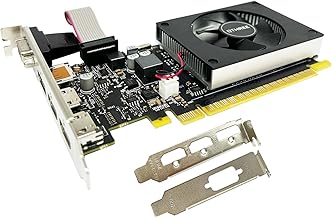
- 4GB DDR3 Memory
- Low Profile Design
- DirectX 12 Support

- 4GB DDR3 Memory
- Low Profile Design
- Multiple Outputs

- Dual HDMI Outputs
- Low Profile Design
- Windows 10/8/7/XP Support

- 2GB DDR3 Memory
- Low Profile Design
- HDMI and VGA Outputs
10 Models Reviewed in Depth
#1. ASUS Dual GeForce RTX 3050
Performance
3 Technology
Resistance
The ASUS Dual GeForce RTX 3050 is a powerhouse for both gaming and demanding productivity tasks, easily handling multiple monitors. You’ll benefit from its 6GB of GDDR6 memory and support for the latest PCIe 4.0 interface, ensuring smooth performance in modern titles and applications. Features like DLSS 3 significantly boost frame rates in supported games.
While it excels in performance, its price point is higher than basic cards. It’s an investment for serious gamers or professionals who need top-tier graphics capabilities. If you’re looking for a card that excels at gaming and can also power multiple high-resolution displays for work, this is an outstanding choice.
Pros
- Excellent gaming performance
- Supports DLSS 3
- Robust build quality
Cons
- Higher price point
- Requires adequate power supply
- Not for very low-end systems
Specifications
#2. RX560 4GB GDDR5 4 HDMI
HDMI Ports
Resolution Support
Office
This RX560 graphics card is an excellent choice for users who need to drive multiple displays, especially for tasks like stock trading or complex office environments. With four HDMI ports, you can easily set up a multi-screen workstation. It supports high resolutions up to 4K at 60Hz, ensuring crisp visuals across all your monitors.
While it offers good multi-monitor capabilities, its gaming performance is modest. It’s best suited for productivity and visual tasks rather than high-end gaming. If maximizing screen real estate for work is your priority, this card delivers.
Pros
- Four HDMI outputs
- Supports 4K resolution
- Good for trading setups
Cons
- Modest gaming performance
- Limited display output types
- Requires multiple monitors
Specifications
#3. GT 740 4GB GDDR5 GPU
HDMI Ports
Memory
Cooling
If you need to drive multiple displays for office work or a home theater, this GT 740 graphics card is a compelling option. Its standout feature is the four HDMI ports, allowing for a quad-monitor setup without needing adapters. The 4GB of GDDR5 memory provides sufficient bandwidth for productivity tasks.
While it excels at multi-display output, this card is not designed for gaming. Its performance is geared towards general computing and media playback. Consider this if your primary need is screen real estate rather than graphical horsepower.
Pros
- Quad HDMI outputs
- GDDR5 memory
- Silent operation
Cons
- Not for gaming
- Limited to HDMI
- Basic performance
Specifications
#4. GT 730 4GB DDR3
4 Displays
Architecture
Video Outputs
This GT 730 graphics card stands out for its ability to support up to four displays, making it a versatile option for multi-monitor setups. With 4GB of DDR3 memory and a combination of HDMI, DisplayPort, and VGA outputs, it offers good connectivity for productivity tasks.
While it handles multiple screens well, its performance is limited to basic desktop use and light media consumption; it’s not suitable for gaming. If your primary goal is to maximize screen real estate for office work or monitoring, this card provides a cost-effective solution.
Pros
- Supports up to 4 displays
- Ample memory for basic use
- Multiple output options
Cons
- Not for gaming
- Basic performance level
- 64-bit memory bus
Specifications
#5. MOUGOL Radeon R7 350 4GB
Design
HDMI Port
Compatible
The MOUGOL AMD Radeon R7 350 is a great option if you need a graphics card for a slim desktop PC. Its half-height design ensures it fits into SFF cases, and the 4GB of GDDR3 memory is adequate for everyday tasks. You get dual HDMI ports for connecting two monitors.
Be aware that this card is not compatible with Windows 11, which might be a dealbreaker for some. Its performance is limited to basic computing and media playback, not gaming. It’s a functional choice for specific slim builds needing dual display output.
Pros
- Designed for SFF PCs
- 4GB memory capacity
- Dual HDMI ports
Cons
- Not Windows 11 compatible
- Limited gaming capability
- Basic performance
Specifications
#6. Glorto GeForce GT 730 4G
Design
Display Outputs
GPU
You’ll appreciate the straightforward functionality of the Glorto GeForce GT 730 for basic dual-monitor setups. Its low-profile design makes it a great fit for smaller PC cases, and the inclusion of multiple display outputs like HDMI, DP, and VGA offers good flexibility.
While it handles everyday tasks and multiple displays well, don’t expect it to power demanding games or intensive creative applications. This card is best suited for office work, web browsing, and media consumption where raw graphical power isn’t the priority.
Pros
- Suitable for SFF PCs
- Multiple display outputs
- Entry-level price point
Cons
- Not for gaming
- Limited performance
- Older architecture
Specifications
#7. QTHREE GeForce GT 730 4GB
Design
12 Support
Display Outputs
The QTHREE GeForce GT 730 is a budget-friendly choice for users needing to connect multiple monitors for general productivity. Its low-profile form factor is ideal for small form-factor PCs, and the combination of HDMI, DP, and VGA ports provides decent connectivity options.
While it supports DirectX 12, this card is strictly for basic tasks like web browsing and office applications; gaming performance will be very limited. If you need a simple, affordable solution for extending your desktop, this card fits the bill.
Pros
- Compact low-profile design
- Versatile display outputs
- Affordable for basic use
Cons
- Weak gaming performance
- 64-bit memory bus
- Basic GPU capabilities
Specifications
#8. Glorto GeForce GT 730 4G
Design
GPU
Friendly
This Glorto GeForce GT 730 is a functional choice for users needing a low-profile graphics card for basic dual-monitor setups in compact PCs. It offers a decent amount of memory for its class and includes essential outputs like HDMI and VGA, making it suitable for everyday computing tasks.
However, its performance is strictly entry-level, meaning it’s not designed for gaming or demanding applications. If you need a simple, affordable card to extend your display for office work or media viewing in a small form-factor PC, this card will suffice.
Pros
- Fits in small cases
- Adequate memory for basic use
- Affordable dual display
Cons
- Very limited performance
- Not suitable for gaming
- Older interface
Specifications
#9. Radeon HD 6570 Graphics Card
OS Support
Design
HDMI
This Radeon HD 6570 is a solid choice if you’re upgrading an older PC or need basic dual-monitor support for legacy systems. Its compatibility with older Windows versions, including XP, is a significant advantage for specific use cases. The dual HDMI ports and low-profile design make it versatile for various builds.
However, its performance is quite dated, so don’t expect it to handle modern applications or gaming. It’s best suited for office tasks, media playback, or as a functional upgrade for systems that don’t require high-end graphics.
Pros
- Wide OS compatibility
- Low profile for small cases
- Dual HDMI ports
Cons
- Very dated performance
- Limited memory
- Not for modern use
Specifications
#10. GeForce GT 610 2G DDR3
Design
GPU
Display Output
The GeForce GT 610 is an entry-level graphics card designed for basic display output and extending your desktop. Its low-profile form factor makes it suitable for compact HTPCs or small form-factor PCs. With HDMI and VGA outputs, it can handle simple dual-monitor setups for everyday tasks.
This card offers minimal performance and is not suitable for gaming or any graphically intensive work. It’s best used for tasks like web browsing, word processing, and media playback where graphical demands are low. Consider this only if your needs are extremely basic.
Pros
- Very compact size
- Low power consumption
- Basic display output
Cons
- Extremely limited performance
- Outdated interface
- Minimal memory
Specifications
Powering Your Dual-Display Dreams: A Graphics Card Guide
Setting up a dual-monitor workstation can dramatically boost your productivity and entertainment. But to drive those extra screens smoothly, you’ll need a capable graphics card. This isn’t a component to overlook; the right video card ensures your extended desktop is responsive, vibrant, and free from frustrating lag. Choosing wisely means more than just picking the first card you see – it’s about finding a balance of performance and features that fits your needs.
Unlocking the Potential of Multiple Displays
When you’re looking to power more than one monitor, several key aspects of a graphics card come into play. Think of these as the building blocks for a seamless visual experience.
- Video Memory (VRAM): More VRAM generally allows for higher resolutions and more complex visual data to be processed simultaneously, which is crucial when pushing content to multiple displays.
- Display Outputs: Ensure the card has the right types and number of ports (like HDMI, DisplayPort) to match your monitors’ inputs.
- Processing Power (GPU Cores): The core processing unit of the graphics card dictates its overall performance. A more powerful GPU will handle rendering tasks for both screens more efficiently.
- Cooling Solution: A robust cooling system is vital to prevent overheating, especially under sustained load from multiple displays, ensuring consistent performance.
- Sticking to your budget: Determine a price range beforehand. You can find capable cards for dual-monitor setups across various price points, so prioritize features that matter most to you within your spending limit.
Navigating the Upgrade Path Without Stumbling
Even with the best intentions, it’s easy to make choices that don’t quite hit the mark. Here are a few common missteps to steer clear of.
- Buying a card with insufficient display outputs for your desired monitor configuration.
- Overspending on a high-end card when your daily tasks don’t demand that level of graphical horsepower.
- Forgetting to check if your computer’s power supply unit (PSU) can adequately support a new, more powerful graphics card.
Your Multi-Monitor Masterpiece Awaits
For robust gaming and demanding multitasking, the ASUS Dual GeForce RTX 3050 is your champion. If your focus is on office productivity, stock trading, or simply expanding your digital workspace, the RX560 with its four HDMI ports is a clear winner. For budget-conscious users needing multiple displays for light desktop use or home theater, the GT 730 and GT 740 series offer excellent value.
No matter your specific needs, these cards deliver the multi-monitor capabilities you’re after. Don’t delay – check the latest availability for your chosen card to get your setup running smoothly!
Final 3 Picks: Gaming and Productivity, Multi-Screen Trading, and Quad Monitor Office
Ready to decide? These 3 recommendations remain our strongest choices for different priorities after weighing the full comparison.


![10 Ti Video Card [2026]](https://spsolutionscare.com/wp-content/uploads/2026/08/10-ti-video-card-2026-featured-768x432.jpg)