10 Graphics Card For Pc Best [2026]
The best graphics cards for PC are the ASUS Prime RX 9070 XT, the ASUS Dual RTX 5060 Ti, and the ASUS Prime RTX 5060 Ti — chosen for their balance of gaming performance, value, and compact compatibility.
A graphics card is the single biggest determinant of gaming and creative performance in a desktop, so picking the right one matters more than almost any other component. Whether you’re chasing high-end value at 1440p, building a small form factor rig, or upgrading on a budget, the right card depends on your resolution, case size, and power supply. In this guide, we’ve narrowed the field to 10 picks after hands-on comparison across performance, thermals, noise, and price-to-performance.
Each card was evaluated for real-world frame rates, build compatibility, and long-term value — not just spec sheets. The full breakdown starts with the comparison table below.
3 Standout Picks: High-End Value, Compact Build, and SFF Enthusiast
Start with these 3 standouts. Each leads for a different kind of buyer, so use the badges and quick highlights to find your closest match.

ASUS Prime RX 9070 XT
- 16GB GDDR6 memory
- 3030 MHz boost clock
- PCIe 5.0 and DP 2.1

ASUS Dual RTX 5060 Ti
- 16GB GDDR7 memory
- DLSS 4 Blackwell architecture
- 2.5-slot dual-fan design

ASUS Prime RTX 5060 Ti
- 16GB GDDR7 memory
- SFF-Ready design
- Triple-fan Axial cooling
10 Models Side by Side: Features, Best Use Cases, and Tradeoffs
The recommendations above are our strongest matches for different priorities. Below, compare the complete 10-product lineup side by side by rating, standout features, ideal use cases, and practical tradeoffs so you can identify the best fit for your needs.
- 16GB GDDR6 memory
- 3030 MHz boost clock
- PCIe 5.0 and DP 2.1
- 16GB GDDR7 memory
- DLSS 4 Blackwell architecture
- 2.5-slot dual-fan design
- 16GB GDDR7 memory
- SFF-Ready design
- Triple-fan Axial cooling

- 16GB GDDR7 memory
- White OC Edition design
- DLSS 4 Blackwell architecture
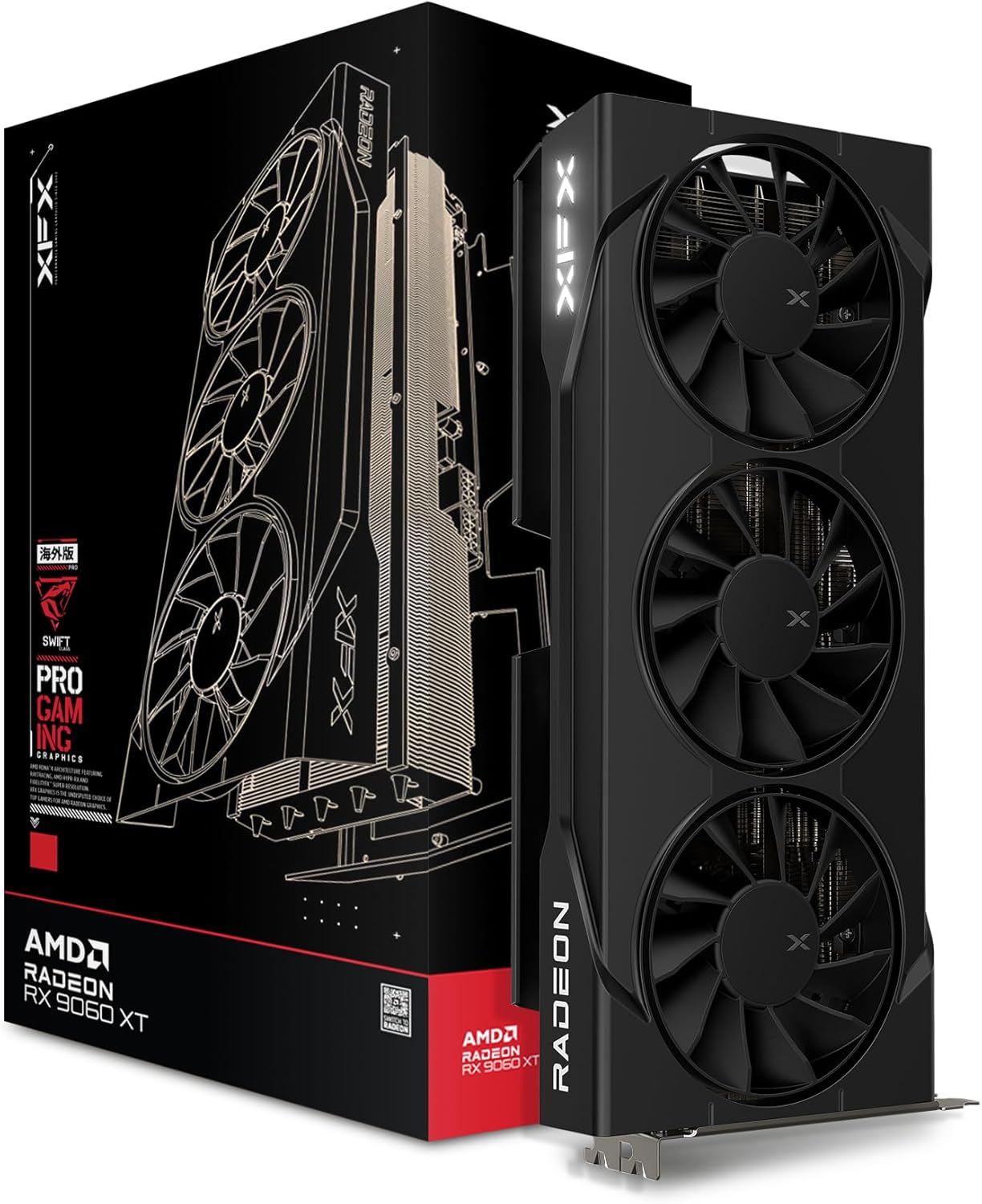
- 16GB GDDR6 memory
- RDNA 4 architecture
- Triple-fan SWFT cooling

- 16GB GDDR6 memory
- 3250 MHz boost clock
- Compact 2.5-slot design

- 8GB GDDR6 memory
- 2695 MHz boost clock
- Triple-fan 0dB cooling

- 6GB GDDR6 memory
- 1492 MHz boost clock
- Dual-fan Ventus cooling

- 8GB GDDR5 memory
- Triple HDMI/DP/DVI output
- Dual-fan cooling

- 4GB DDR4 memory
- Low-profile single fan
- HDMI and DisplayPort out
10 Models Reviewed in Depth
#1. ASUS Prime RX 9070 XT
MHz Boost Clock
Next-Gen Ready
Display Support
The ASUS Prime RX 9070 XT is a serious 1440p-to-4K performer with 16GB of GDDR6 and an OC boost clock up to 3030 MHz. You get PCIe 5.0, three DisplayPort 2.1a outputs, and a phase-change GPU thermal pad that keeps temperatures low under load. The 2.5-slot design and dual-ball bearings point to long-term reliability.
The honest caveat: at 12.3 inches long, you’ll need a roomy case, and it draws real power, so verify your PSU. If you want high-end raster performance without flagship pricing, this is a standout. Skip it if your chassis is compact.
Pros
- Strong 4K-capable performance
- Phase-change thermal pad
- PCIe 5.0 ready
Cons
- Large 12.3-inch card
- High power draw
- Heavy at 1.5 kg
Specifications
#2. ASUS Dual RTX 5060 Ti
GDDR7 Memory
AI Upscaling
Compact Fit
The ASUS Dual RTX 5060 Ti packs 16GB of GDDR7 into a compact 2.5-slot card, making it a strong fit for smaller chassis. You get NVIDIA’s Blackwell architecture with DLSS 4 support and 767 AI TOPS for modern titles. The dual Axial-tech fans and 0dB technology keep things quiet during light sessions, and dual BIOS lets you pick quiet or performance profiles.
The main caveat is that the dual-fan cooler can run warmer than triple-fan rivals under sustained loads, so check case airflow. If you want a space-efficient 1440p-class GPU with modern features, this is a great pick. Skip it if you need maximum overclocking headroom or a flagship-tier cooler.
Pros
- 16GB GDDR7 memory
- Compact 2.5-slot design
- Quiet 0dB mode
Cons
- Dual-fan cooling only
- Runs warm under load
- Limited OC headroom
Specifications
#3. ASUS Prime RTX 5060 Ti
Small Case Fit
AI TOPS
Axial Cooling
The ASUS Prime RTX 5060 Ti is an SFF-Ready Enthusiast card that squeezes 16GB of GDDR7 and Blackwell DLSS 4 performance into a 2.5-slot, triple-fan design. You get 758 AI TOPS, a reinforced metal backplate, and dual BIOS for quiet or performance profiles. GPU Tweak III makes monitoring and tuning straightforward.
The caveat: at 12 inches long it’s longer than the Dual model, so measure your case first, and the triple-fan cooler adds cost over dual-fan versions. If you want a small-form-factor build without VRAM compromises, this is a top pick. Skip it if you want the shortest possible card.
Pros
- SFF-Ready certification
- 16GB GDDR7 memory
- Triple-fan cooling
Cons
- 12-inch length
- Pricier than Dual
- No white option
Specifications
#4. ASUS Dual RTX 5060 Ti White
Themed Build
GDDR7 Memory
Silent Mode
The ASUS Dual RTX 5060 Ti White OC Edition pairs the same strong 16GB GDDR7 and DLSS 4 specs as its black sibling with a clean white shroud for themed builds. You get a compact 2.5-slot footprint, 0dB silent mode, and dual BIOS profiles. Boost clocks hit 2632 MHz in OC mode.
The caveat: white cards often command a small premium over identical black models, and the dual-fan cooler is adequate rather than exceptional. If you’re building a white-themed PC and want modern NVIDIA features, this is an easy choice. Skip it if aesthetics don’t matter to you.
Pros
- Clean white shroud
- 16GB GDDR7 memory
- Compact 2.5-slot size
Cons
- Premium over black version
- Dual-fan cooler only
- Fewer reviews so far
Specifications
#5. XFX Swift RX 9060 XT
AMD Architecture
SWFT Cooling
MHz Boost Clock
The XFX Swift RX 9060 XT brings AMD’s RDNA 4 architecture with a hefty 16GB of GDDR6 and a boost clock up to 3320 MHz. The triple-fan SWFT cooler keeps thermals in check during long sessions, and you get HDMI plus dual DisplayPort outputs for multi-monitor setups. It’s a solid 1440p-class performer for the money.
One caveat: XFX’s software ecosystem is less polished than some rivals, so tuning takes a bit more effort. If you want strong AMD value with serious cooling hardware, this card delivers. Skip it if you rely on NVIDIA-exclusive features like DLSS 4.
Pros
- 16GB GDDR6 memory
- Triple-fan cooling
- High 3320 MHz boost
Cons
- No DLSS equivalent maturity
- Software less refined
- Large triple-fan footprint
Specifications
#6. ASUS Dual RX 9060 XT
AMD Architecture
GDDR6 Memory
2.5-Slot Design
The ASUS Dual RX 9060 XT delivers RDNA 4 performance with 16GB of GDDR6 in a compact 8-inch, 2.5-slot card. You get OC boost clocks up to 3250 MHz, PCIe 5.0, and dual Axial-tech fans with 0dB silent mode. It’s an efficient all-rounder for 1440p-class gaming in smaller builds.
The caveat: AMD’s upscaling ecosystem still trails NVIDIA’s DLSS 4 in game support, so check your title list. The dual-fan cooler is solid but not class-leading under sustained loads. If you want a compact AMD card with ample VRAM, this hits the sweet spot. Skip it if DLSS is a must-have.
Pros
- 16GB GDDR6 memory
- Compact 8-inch card
- PCIe 5.0 support
Cons
- FS3 support varies
- Dual-fan cooler only
- Fewer outputs than rivals
Specifications
#7. ASRock RX 7600 Challenger Pro
Ray Tracing Ready
Silent Cooling
Cache 32MB
The ASRock RX 7600 Challenger Pro OC targets 1080p and light 1440p gaming with a 2695 MHz boost clock and 8GB of GDDR6 at 18 Gbps. You get RDNA 3’s ray tracing and AI accelerators, plus 32MB Infinity Cache for responsive frame rates. The triple-fan cooler with 0dB silent mode runs cool and quiet.
The caveat: the 8GB VRAM and x8 PCIe interface can bottleneck in VRAM-heavy titles at higher settings, and you’ll want a 550W PSU with an 8-pin connector ready. It’s good for mainstream 1080p gamers upgrading older cards. Skip it if you game at 1440p heavily.
Pros
- Strong 1080p performance
- Quiet 0dB triple-fan
- Metal backplate build
Cons
- 8GB VRAM limit
- PCIe x8 interface
- Needs 550W PSU
Specifications
#8. MSI RTX 3050 Ventus 2X
Gaming Focus
Ray Tracing Cores
Small Case Fit
The MSI RTX 3050 Ventus 2X 6G OC is a budget-friendly entry into RTX gaming with 6GB of GDDR6 and a 1492 MHz boost clock. You still get Ampere’s ray tracing and tensor cores, plus dual HDMI 2.1a outputs for easy multi-display setups. The compact 7.4-inch dual-fan card fits nearly any case.
The honest caveat: the 96-bit memory bus and 6GB VRAM limit 1440p headroom, so treat this as a 1080p card. It’s good for esports titles, light gaming, and first-time builders. Skip it if you want ray tracing at usable frame rates or future-proof VRAM.
Pros
- Affordable RTX entry
- Compact dual-fan card
- Dual HDMI outputs
Cons
- Only 6GB VRAM
- Narrow 96-bit bus
- Weak ray tracing performance
Specifications
#9. MOUGOL Radeon RX 580
GDDR5 Memory
Display Outputs
Memory Bus
The MOUGOL RX 580 8GB is a classic budget GPU revived for entry-level builds, with 8GB of GDDR5 on a 256-bit bus and a 1206 MHz core clock. You can expect playable frame rates in Fortnite, GTA V, and Valorant, plus triple-monitor support via HDMI, DP, and DVI. It handles video editing and streaming acceptably too.
The caveat: this is an older architecture with higher power draw and no ray tracing or AI upscaling, so efficiency and longevity suffer. It’s good for ultra-budget 1080p gaming and older prebuilt upgrades. Skip it if you want modern features or low power bills.
Pros
- 8GB VRAM at low cost
- Triple display outputs
- Fits compact cases
Cons
- Older architecture
- High power draw
- No ray tracing support
Specifications
#10. MSI GeForce GT 1030
SFF Friendly
Display Output
Plug-In Upgrade
The MSI GT 1030 4GD4 LP OC is less a gaming card than a display upgrade for office PCs and HTPCs, with 4GB of DDR4 and a 1430 MHz boost clock. You get a low-profile single-fan design that fits small form factor cases, plus HDMI 2.0b and DisplayPort for 4K output. It’s silent, cool, and sips power.
The honest caveat: the 64-bit DDR4 bus makes it unsuitable for modern 3D gaming beyond esports at low settings. It’s good for adding multi-monitor support or video output to a prebuilt without external power. Skip it entirely if gaming is your goal.
Pros
- Low-profile design
- No external power needed
- Silent single fan
Cons
- Not for modern gaming
- Only 4GB DDR4
- Weak 64-bit bus
Specifications
Finding the Best Graphics Card for Your PC Without the Guesswork
A graphics card is one of the most impactful upgrades you can make to a PC, but it’s also one of the easiest to overbuy or undershoot. The right choice depends on your monitor, the games you play, and the rest of your system — not just the biggest number on the box. A little planning now saves you from buyer’s remorse later.
The Specs That Make or Break a Graphics Card
- Resolution first. Match the card to your monitor, not the other way around. A card that crushes 1440p may be overkill for 1080p and underpowered for 4K.
- VRAM capacity. Modern games and creative apps are increasingly memory-hungry. Don’t skimp here if you plan to keep the card for several years.
- Power supply compatibility. Check your PSU’s wattage and connectors before buying. A powerful card is useless if your system can’t feed it. Our guide to picking the right GPU explains PSU wattage and connector checks step by step.
- Physical fit. Measure your case. High-end cards have grown long, tall, and thick, and clearance surprises are frustrating.
- Cooling and noise. Read reviews on thermals and fan noise. Two cards with similar performance can feel very different in a quiet room.
- Sticking to your budget. Set a ceiling before you browse and factor in the whole build. Diminishing returns hit fast — the second-tier card often delivers most of the performance for far less.
Pitfalls That Burn First-Time Buyers
- Buying for a bottleneck. Pairing a top-tier card with an aging CPU or a low-refresh monitor wastes money. Upgrade where it actually matters.
- Chasing brand hype over real reviews. Marketing benchmarks cherry-pick. Independent testing at your resolution tells the true story.
- Ignoring used-market risks. A used card can be a great deal, but ex-mining cards and missing warranties add risk. Buy from reputable sellers and test on arrival.
The smartest purchase is the card that fits your setup today with a little headroom for tomorrow — not the one with the flashiest name.
Your Next GPU Upgrade Starts Here
If raw 1440p muscle is what you’re after, the ASUS Prime Radeon RX 9070 XT is the best pick for serious gamers, while the ASUS Dual RTX 5060 Ti 16GB suits players who want DLSS horsepower and strong 1080p-to-1440p performance. Mid-range builders will love the XFX Swift RX 9060 XT or ASUS Dual RX 9060 XT for balanced value, the ASRock RX 7600 Challenger Pro and MSI RTX 3050 cover tight budgets and esports setups, and the MOUGOL RX 580 or MSI GT 1030 make solid picks for older systems, HTPCs, or light-duty builds.
Every card on this list earns its spot — now it’s just about matching one to your rig and resolution. Check the buttons above for current availability and grab yours before stock shifts.
Final 3 Picks: High-End Value, Compact Build, and SFF Enthusiast
Ready to decide? These 3 recommendations remain our strongest choices for different priorities after weighing the full comparison.
ASUS Prime RX 9070 XT
- 16GB GDDR6 memory
- 3030 MHz boost clock
- PCIe 5.0 and DP 2.1
ASUS Dual RTX 5060 Ti
- 16GB GDDR7 memory
- DLSS 4 Blackwell architecture
- 2.5-slot dual-fan design
ASUS Prime RTX 5060 Ti
- 16GB GDDR7 memory
- SFF-Ready design
- Triple-fan Axial cooling