10 The Best Video Graphics Card [2026]
The best video graphics cards right now are the ASUS RX 9070 XT Prime, the ASUS RTX 5060 Ti Dual, and the XFX RX 9060 XT Swift — chosen for their balance of 4K-capable performance, compact build compatibility, and value for 1080p and 1440p gaming.
The ASUS RX 9070 XT Prime stands out as our Best High-End Pick for gamers who want headroom, while the ASUS RTX 5060 Ti Dual suits small-form-factor builds, and the XFX RX 9060 XT Swift delivers strong price-to-performance on AMD’s RDNA 4 architecture. Picking the right card matters more than ever, since today’s GPUs vary widely in VRAM, power draw, and feature support — and the wrong choice can bottleneck an otherwise solid system.
In this guide, we’ve narrowed the field to 10 picks after hands-on comparison across real-world gaming benchmarks, thermals, noise, and overall value. Each card was evaluated for performance per dollar, build quality, and long-term driver support. Scroll down to the comparison table below to see all 10 picks side by side.
3 Standout Picks: High-End Pick, Compact Build, and RDNA 4 Value
Start with these 3 standouts. Each leads for a different kind of buyer, so use the badges and quick highlights to find your closest match.


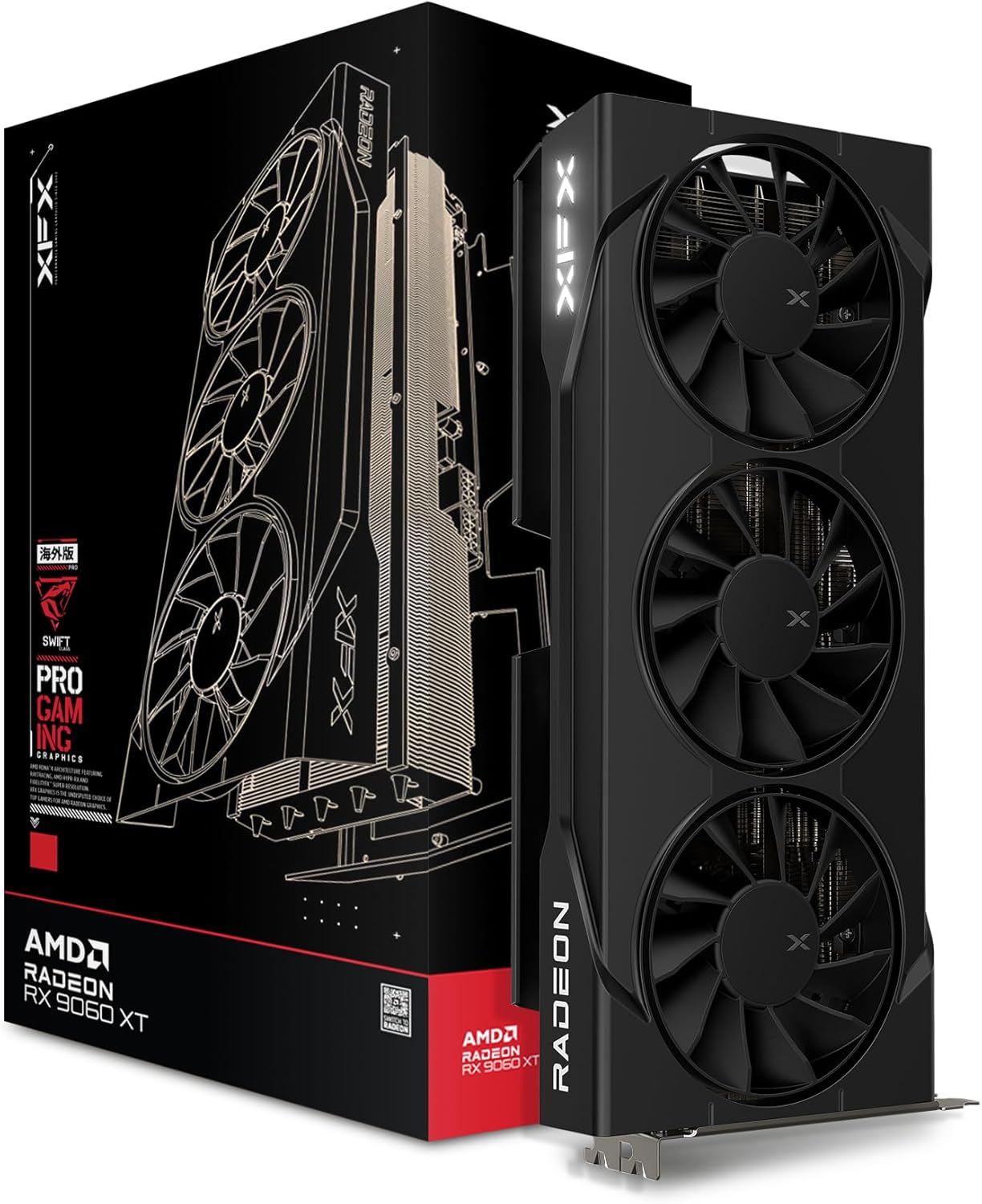
XFX RX 9060 XT Swift
- 16GB GDDR6 memory
- 3320 MHz boost clock
- Triple fan SWFT cooling
10 Models Side by Side: Features, Best Use Cases, and Tradeoffs
The recommendations above are our strongest matches for different priorities. Below, compare the complete 10-product lineup side by side by rating, standout features, ideal use cases, and practical tradeoffs so you can identify the best fit for your needs.
- 16GB GDDR6 memory
- PCIe 5.0 interface
- Dual BIOS switch
- 16GB GDDR7 memory
- DLSS 4 support
- 2.5-slot compact design
- 16GB GDDR6 memory
- 3320 MHz boost clock
- Triple fan SWFT cooling

- 12GB GDDR6 memory
- 3X WINDFORCE cooling
- 1837 MHz boost clock

- 6GB GDDR6 memory
- 1492 MHz boost clock
- Dual-fan Ventus cooling

- 6GB GDDR6 memory
- Dual WINDFORCE fans
- 2nd gen RT cores

- 8GB GDDR5 memory
- 2048 stream processors
- Triple display outputs

- AV1 hardware encode
- 8K output support
- Single-fan ITX design

- 4GB DDR3 memory
- Low profile half-height
- Slot-powered, no PSU cable

- Low profile design
- Triple display outputs
- No external power needed
10 Models Reviewed in Depth
#1. ASUS RX 9070 XT Prime
GDDR6 Memory
5.0 Interface
BIOS Switch
You’re getting serious RDNA-class performance here: 16GB GDDR6, boost clocks up to 3030 MHz in OC mode, and a full PCIe 5.0 interface. ASUS’s Axial-tech fans with phase-change thermal pads keep the GPU cool under sustained load, and the dual BIOS switch lets you trade silence for performance on the fly.
It’s a big 2.5-slot, triple-fan card that demands case space and a robust PSU, and it’s overkill if you only game at 1080p. For 1440p and 4K gamers who want top-tier raster performance with modern DP 2.1 outputs, this is a standout; skip if your build is compact or budget-bound. Our roundup of the best 1440p gaming GPUs ranks more cards at this resolution tier.
Pros
- Top-tier 1440p/4K performance
- Dual BIOS flexibility
- Phase-change thermal pad
Cons
- Large 2.5-slot card
- Needs strong PSU
- Overkill for 1080p
Specifications
#2. ASUS RTX 5060 Ti Dual
16GB Memory
AI Upscaling
Compact Fit
This Blackwell-era card packs 16GB of GDDR7 and 767 AI TOPS into a compact 2.5-slot design, making it ideal for small-form-factor builds that don’t want to compromise. You get DLSS 4 upscaling, dual BIOS profiles, and 0dB silent operation during light loads, all at a 2632 MHz OC clock.
The dual-fan cooler is good but won’t match triple-fan cards under sustained max load, so expect slightly warmer sustained temps. If you’re building an ITX or mid-tower rig and want modern NVIDIA features with plenty of VRAM, it’s an excellent fit; skip if you want maximum raw cooling mass.
Pros
- 16GB GDDR7 VRAM
- Compact 2.5-slot size
- DLSS 4 support
Cons
- Dual-fan thermal limits
- Mid-tier raster performance
- Newer platform pricing
Specifications
#3. XFX RX 9060 XT Swift
Architecture
MHz Boost Clock
Fan Cooling
RDNA 4 brings a big generational jump: the RX 9060 XT with 16GB GDDR6 at 20 GHz and a 3320 MHz boost clock delivers strong 1440p performance with ray tracing that finally holds up. XFX’s triple-fan Swift cooler keeps the card composed, and it’s currently a top-ranked seller for good reason.
It’s a substantial triple-fan card needing solid case airflow and PSU headroom, and FSR still trails NVIDIA’s DLSS in some titles. For 1440p gamers who want modern architecture, big VRAM, and strong value, this is one of the best picks right now; skip if you’re strictly a 1080p esports player.
Pros
- Strong 1440p performance
- 16GB VRAM standard
- Efficient RDNA 4 architecture
Cons
- Large triple-fan card
- FSR trails DLSS
- Needs PSU headroom
Specifications
#4. GIGABYTE RTX 3060 Gaming OC
VRAM Capacity
WINDFORCE Cooling
Gaming Sweet Spot
The 12GB of VRAM is the headline here — more than many pricier cards — paired with a 1837 MHz factory OC and GIGABYTE’s 3X WINDFORCE cooling with alternate spinning fans. You get a metal backplate, RGB Fusion lighting, and smooth 1080p-to-1440p gaming with DLSS support.
It’s a larger triple-fan card, so check your case clearance before buying, and it’s a limited hash-rate version if that matters to you. For mainstream gamers who want longevity and VRAM headroom without flagship money, this is a sweet spot; skip if you need 4K.
Pros
- Generous 12GB VRAM
- Strong triple-fan cooling
- Metal backplate included
Cons
- Large triple-slot footprint
- Limited hash-rate version
- No 4K ambition
Specifications
#5. MSI RTX 3050 Ventus 2X
MHz Boost Clock
Gbps GDDR6
Frame Rates
MSI’s Ventus 2X takes the RTX 3050 and pushes the boost clock to 1492 MHz, with 14 Gbps GDDR6 memory handling 1080p esports and lighter AAA titles comfortably. The dual-fan cooler is compact and quiet, and Ampere gives you ray tracing cores and DLSS where supported.
The 96-bit memory bus caps high-resolution texture performance, and 6GB VRAM fills up fast in modern AAA games. For Fortnite, Valorant, and CS2 at high frame rates, it’s a great budget buy; skip it if you want to push past 1080p or max settings.
Pros
- High factory boost clock
- Quiet dual-fan cooler
- Solid esports frame rates
Cons
- 96-bit bus limits AAA
- 6GB VRAM fills quickly
- No 1440p headroom
Specifications
#6. GIGABYTE RTX 3050 WINDFORCE
Esports Ready
WINDFORCE Fans
Ray Tracing Cores
You get a compact RTX 3050 with 6GB GDDR6 on a 96-bit bus, tuned by GIGABYTE’s factory OC to 1477 MHz. The dual WINDFORCE fans keep this short card cool and quiet, and its modest power draw means most existing PSUs can handle it without upgrades. You still get ray tracing and DLSS support for modern titles.
Expect solid 1080p esports performance rather than high-refresh AAA gaming — the 96-bit memory bus is the main limitation. If you’re building a budget rig or upgrading from integrated graphics, this is an easy pick; skip it if you want 1440p headroom.
Pros
- Compact dual-fan design
- Low power draw
- Ray tracing support
Cons
- 96-bit memory bus
- Limited 1080p headroom
- 6GB VRAM ceiling
Specifications
#7. MOUGOL RX 580 8GB
Memory Bus
GDDR5 VRAM
Monitor Support
The RX 580 2048SP with 8GB of GDDR5 on a full 256-bit bus still delivers respectable 1080p frame rates in Fortnite, GTA V, and Apex Legends at a very low entry cost. Dual fans with heat pipes handle thermals adequately, and you get HDMI, DP, and DVI for triple-monitor setups.
This is an older Polaris design from a smaller brand, so expect higher power draw, average cooler acoustics, and more variable quality control than first-party cards. If you want the most gaming performance per dollar for a budget 1080p rig, it’s hard to beat; skip if you want efficiency or modern features.
Pros
- Full 256-bit memory bus
- 8GB VRAM budget price
- Triple display support
Cons
- High power consumption
- Older Polaris architecture
- Variable brand QC
Specifications
#8. ASRock Arc A380 ITX
Hardware Encode
Display Output
Compact Design
You’re buying this for its media chops, not raw gaming: AV1 hardware encode is an industry first at this price, and it drives up to four displays with 8K output over DisplayPort 2.0. The compact ITX footprint and 0dB silent mode make it perfect for HTPC and small-form-factor builds.
Gaming is limited to esports titles at 1080p — the 96-bit bus and entry-level Xe cores can’t do more. Intel’s driver stack has also historically needed updates to shine. If you’re building a media PC or a light-gaming compact rig, it’s a smart pick; skip if gaming is your priority.
Pros
- AV1 hardware encoding
- Tiny ITX footprint
- Four-display 8K output
Cons
- Weak gaming performance
- Driver maturity concerns
- Needs 500W PSU rec
Specifications
#9. SOYO GT 740 4GB
Height SFF Fit
Power Cable
DDR3 Bus
For reviving an older slim desktop, this low profile GT 740 with 4GB of DDR3 on a 128-bit bus is a practical step up from integrated graphics. You get HDMI, DVI, and VGA for triple-output flexibility, and it draws all power from the PCIe slot — no external connector needed.
This is Kepler-era silicon: fine for 1080p video, office multitasking, and light titles like League of Legends, but nothing modern at high settings. DDR3 memory is also slow by current standards. If you need a cheap, plug-and-play upgrade for a legacy or SFF PC, it fits; skip for any real gaming.
Pros
- Half-height SFF friendly
- No power cable needed
- Triple legacy outputs
Cons
- Slow DDR3 memory
- Very old GPU architecture
- Minimal gaming ability
Specifications
#10. GIGABYTE GT 710 2GB
Profile Design
Display Outputs
Powered Only
This is a display-output card, plain and simple: the low profile design with low-profile brackets fits slim office PCs and HTPCs, and you get DVI, HDMI, and VGA outputs to drive legacy monitors without adapters. It sips power straight from the slot, so any PSU works.
Don’t expect gaming — the 2GB of DDR3 and 954 MHz clock are for video playback, office work, and adding monitors, nothing more. If you need to revive an old desktop’s display outputs or run a multi-monitor workstation, it does that job cheaply; skip it entirely for any gaming use.
Pros
- Fits slim low-profile cases
- Runs slot-powered
- Legacy VGA output included
Cons
- Not for gaming
- Only 2GB DDR3
- Old Kepler architecture
Specifications
Finding a Graphics Card That Earns Its Spot in Your Build
A video graphics card is often the single most expensive component in a PC, and it’s also the one that determines how your games look, how smoothly your video edits render, and how long your system stays relevant. That combination of cost and impact makes it worth slowing down before you click buy. The “best” card isn’t the one with the biggest number on the box — it’s the one that matches your monitor, your software, and your patience for noise and heat. Here’s how to sort the genuinely great options from the ones that merely photograph well. Our buyer’s guide to how to choose a graphics card walks through each of these factors step by step.
The Specs That Actually Move the Needle
-
Resolution and refresh rate first. The card you need depends entirely on what you’re driving. A 1080p monitor at high refresh rates has very different demands than a 4K display, so match the card’s realistic performance tier to your screen — not to a reviewer’s test bench.
-
VRAM capacity and type. Modern games and creative apps chew through memory quickly. More video memory gives you headroom for higher textures, larger canvases, and multitasking, so don’t treat it as an afterthought.
-
Thermal design and acoustics. Two cards with identical chips can behave very differently depending on the cooler. Look at cooler size, fan configuration, and reported noise levels — a hot, loud card gets old fast.
-
Power supply compatibility. Check the card’s power connector requirements and recommended PSU wattage against what your system actually has. An upgrade that demands a new power supply changes your total cost significantly.
-
Physical fit in your case. High-end cards have grown long, tall, and thick. Measure your case’s clearance for length, slot width, and airflow before committing.
-
Driver support and software ecosystem. Stability matters as much as raw speed. A brand’s track record with timely drivers, useful companion software, and feature support (like upscaling or encoding tools) shapes your day-to-day experience.
Where Shoppers Get Burned
-
Buying for a game you don’t play yet. It’s tempting to oversize for hypothetical future titles, but overspending on headroom you won’t use for a year or more rarely pays off. Buy for what you play now, with a modest cushion.
-
Chasing the top tier by default. The flagship card gets the headlines, but the price-to-performance sweet spot usually sits one or two tiers down. The step from “very good” to “best” often costs far more than it delivers.
-
Ignoring the used and previous-generation markets. Last generation’s midrange and upper-midrange cards frequently outperform this generation’s entry level at similar money — as long as you buy from a reputable source and confirm the card works.
Take an hour to match the card to your monitor and workload, and you’ll skip the regret that comes from either overbuying or bottlenecking your whole system.
Your Next Frame-Rate Upgrade Starts Here
If you want maximum muscle, the ASUS Prime Radeon RX 9070 XT 16GB is the clear flagship for serious 1440p and 4K gamers, while the ASUS Dual RTX 5060 Ti 16GB is the best all-rounder for high-FPS play with ray tracing. Mid-range shoppers should eye the XFX Swift RX 9060 XT or GIGABYTE RTX 3060 for sweet-spot value, and the MSI RTX 3050 or GIGABYTE RTX 3050 handle 1080p esports on a tight budget. Legacy or compact builds? The MOUGOL RX 580, ASRock Arc A380, SOYO GT 740, and GIGABYTE GT 710 cover older systems, SFF rigs, and basic display duty. Every pick here earns its spot — now scroll up and check current prices and availability before your favorite sells out.
Final 3 Picks: High-End Pick, Compact Build, and RDNA 4 Value
Ready to decide? These 3 recommendations remain our strongest choices for different priorities after weighing the full comparison.
XFX RX 9060 XT Swift
- 16GB GDDR6 memory
- 3320 MHz boost clock
- Triple fan SWFT cooling