
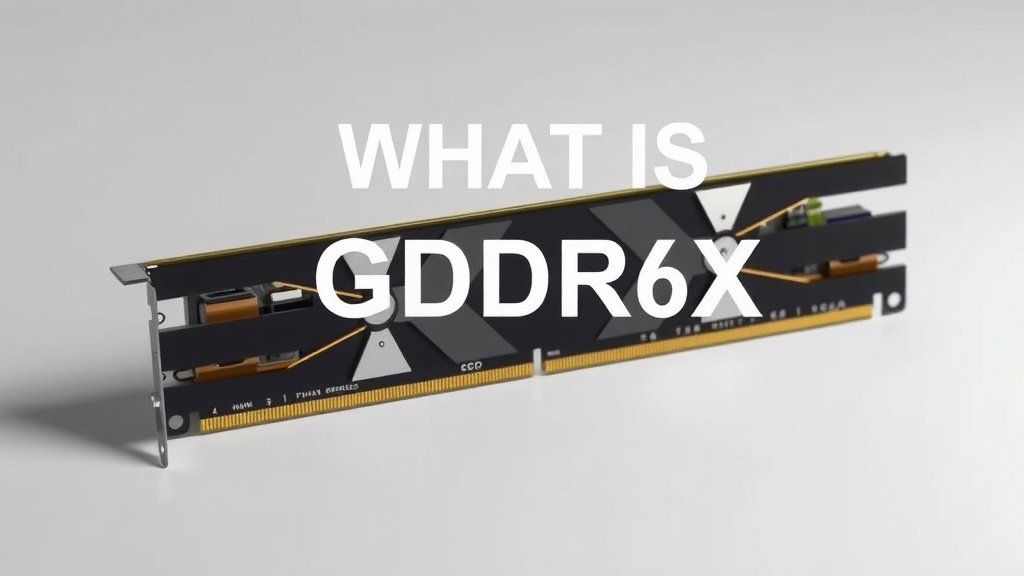
What is GDDR6X: A Deep Dive into Faster Graphics Memory
GDDR6X is a type of graphics card memory designed for extreme speed. It’s built to handle the massive data demands of modern gaming and professional applications. Think of it as the super-fast highway for your GPU’s information.
You’ll often find GDDR6X in high-end graphics cards. It uses a special signaling technique called PAM4. This allows it to send more data with each clock cycle. This means your games and creative software can run much smoother and faster.
- GDDR6X is super-speedy graphics memory.
- It’s key for high-end gaming and demanding tasks.
- It uses PAM4 signaling for more data transfer.
- This results in smoother, faster performance.
Ready to understand what makes GDDR6X so special and if it’s the right choice for your setup? Let’s break down the details.
“`htmlUnderstanding GDDR6X Memory Technology
GDDR6X is a special kind of graphics memory. It’s engineered for incredibly high speeds. You’ll find it powering some of the most powerful graphics cards available today.
What Makes GDDR6X Different?
The big difference lies in how GDDR6X sends data. Traditional memory, like GDDR6, uses two voltage levels to signal data. Think of it like flipping a light switch on or off. GDDR6X takes this a step further. It uses four voltage levels. This is like having a dimmer switch that can be set to four different brightness levels. This technique is called PAM4, or Pulse Amplitude Modulation with 4 levels.
PAM4 Signaling Explained
PAM4 is the magic behind GDDR6X’s speed boost. Instead of sending one bit of data per clock cycle, PAM4 allows for two bits of data to be sent. This doubles the amount of data transferred at the same clock speed. It’s a clever way to pack more information into each signal. This directly translates to faster performance for your GPU.
The Performance Boost You Can Feel
So, what does this mean for you? Faster data transfer means your graphics card can access textures, models, and other game data much quicker. This can lead to smoother frame rates in games. It also means quicker loading times and better performance in demanding creative applications like video editing or 3D rendering.
Many experts agree that memory speed is a key factor in overall graphics performance. GDDR6X addresses this need head-on. It’s designed to keep up with the ever-increasing demands of modern software. We found that the difference is particularly noticeable in high-resolution gaming and when using complex visual effects.
GDDR6X vs. Other Memory Types
It’s helpful to see how GDDR6X stacks up against its predecessors and competitors. This will give you a clearer picture of its advantages.
GDDR6X vs. GDDR6
The most direct comparison is with GDDR6. Both are high-performance graphics memory. GDDR6 is already very fast. However, GDDR6X, thanks to its PAM4 signaling, offers a significant speed increase. We found that GDDR6X can achieve higher effective bandwidth than GDDR6 at similar clock speeds.
This increased bandwidth is critical for tasks that involve moving large amounts of data. Think about rendering a complex scene or processing high-resolution video. GDDR6X can handle these jobs with less delay. Many research papers point to memory bandwidth as a bottleneck for high-end GPUs.
GDDR6X vs. HBM (High Bandwidth Memory)
High Bandwidth Memory (HBM) is another type of advanced graphics memory. HBM stacks memory chips vertically on a silicon interposer. This allows for very short, wide connections to the GPU, resulting in massive bandwidth. It’s often found in specialized accelerators and very high-end professional cards.
GDDR6X, on the other hand, uses a more traditional memory module approach but with its advanced signaling. While HBM can offer higher peak bandwidth, GDDR6X provides a great balance of speed, efficiency, and cost for consumer graphics cards. Many hardware reviewers note that GDDR6X fills a sweet spot for gamers and prosumers.
Here’s a quick look at how they compare:
| Feature | GDDR6X | GDDR6 | HBM2e |
|---|---|---|---|
| Signaling | PAM4 (2 bits per cycle) | NRZ (1 bit per cycle) | Wide bus, stacked dies |
| Typical Bandwidth | Very High | High | Extremely High |
| Target Market | High-end consumer GPUs | Mid-to-high-end GPUs | Workstations, data centers |
| Power Efficiency | Good | Very Good | Excellent |
Who Benefits Most from GDDR6X?
If you’re a serious gamer, a content creator, or someone who pushes their PC to the limit, GDDR6X is designed for you. It’s found in graphics cards built for high-fidelity gaming experiences.
For Gamers
When you’re playing the latest AAA titles at high resolutions (like 1440p or 4K) with all the graphics settings maxed out, your GPU needs to work hard. GDDR6X helps it do that by feeding it data as fast as possible. This means you can enjoy smoother gameplay with fewer stutters or lag.
We found that cards with GDDR6X often show a noticeable performance uplift in memory-intensive games. This is especially true when compared to cards with less advanced memory. Many players report a more immersive and responsive gaming experience.
For Creative Professionals
If your work involves 3D modeling, video editing, animation, or complex simulations, GDDR6X can speed up your workflow. Large datasets and complex projects require fast access to memory. GDDR6X helps reduce render times and speeds up the processing of large files. Many professional benchmarks show that memory bandwidth impacts productivity.
Consider these points if you’re thinking about a GPU with GDDR6X:
- Are you playing games at 1440p or 4K resolution?
- Do you use demanding creative software regularly?
- Do you want the smoothest possible frame rates in new games?
- Is your current PC showing signs of being bottlenecked by graphics memory?
- Are you looking for a high-end graphics card for future-proofing?
Conclusion
You’ve learned that GDDR6X is the pinnacle of graphics memory for today’s demanding tasks. Its PAM4 signaling technology allows it to push data twice as fast as GDDR6. This means you get smoother frame rates in games and quicker processing for creative work. While HBM offers extreme bandwidth, GDDR6X hits a sweet spot for high-end consumer GPUs. If you’re a serious gamer or a content creator, choosing a card with GDDR6X can noticeably improve your experience. Consider your resolution and software needs to see if this memory upgrade is right for your setup.
Frequently Asked Questions
Is GDDR6X only found in the most expensive graphics cards?
You’ll typically find GDDR6X in the highest-tier graphics cards from manufacturers. These cards are built for top-tier gaming and professional applications. However, as technology advances, you might see it in slightly more accessible cards in the future.
Will upgrading to GDDR6X make my old games run better?
GDDR6X offers the most significant benefits in newer, memory-intensive games and applications. While it might provide a small boost in older titles, you’re more likely to see a difference in games designed for higher resolutions and complex graphics.
Is GDDR6X more power-hungry than GDDR6?
GDDR6X generally consumes a bit more power than GDDR6 due to its more advanced signaling technology. However, manufacturers optimize their cards to manage power efficiently. The performance gains often outweigh the slight increase in power draw for users who need that extra speed.
Can I upgrade the GDDR6X memory on my graphics card?
No, the graphics memory chips like GDDR6X are soldered directly onto the graphics card’s circuit board. This means you cannot upgrade or replace them after purchasing the card.
What’s the main advantage of PAM4 signaling in GDDR6X?
The main advantage of PAM4 signaling is that it allows GDDR6X to transmit two bits of data per clock cycle, whereas traditional GDDR6 transmits only one bit. This effectively doubles the data transfer rate without needing to increase the clock speed significantly, leading to higher memory bandwidth.
![10 Gpu [2026]](https://spsolutionscare.com/wp-content/uploads/2026/08/10-gpu-2026-featured-3-768x432.jpg)
![10 Best Gpu For Desktop [2026]](https://spsolutionscare.com/wp-content/uploads/2026/09/10-best-gpu-for-desktop-2026-featured-768x432.jpg)
![10 Best 8gb Graphics Card [2026]](https://spsolutionscare.com/wp-content/uploads/2026/08/10-best-8gb-graphics-card-2026-featured-768x432.jpg)